
Heat pump repair in Mesa, cooling side and heating side
JB repairs heat pumps across Mesa. The same cabinet that cooled the house all summer heats it in December, so which mode failed is the first thing to tell us.
- 4.9 · 580 Google reviews
- CR-39 licensedROC #341937 · CR-39
- Since 1981Family owned since 1981
- Open 24/7
In one paragraph
A heat pump is an air conditioner with a reversing valve, so the same equipment cools the house in summer and moves heat into it in winter, and repairing one begins by establishing which of those two modes failed, because a cooling fault and a heating fault sit in different parts of the same machine.
One machine, two directions
It cooled all summer, so it did not lose its compressor
Everything a heat pump does to cool, a straight-cool air conditioner does the same way, with the same parts. A system that ran without complaint through August and then fails to heat in December has almost certainly not lost the hardware it just proved. That narrows a winter fault to three places, and only three.
Shared cooling hardware
Identical to any air conditioner, and proven over months of summer run time.
- Compressor
- Indoor and outdoor coils
- Sealed refrigerant circuit
- Run capacitor and contactor
Heating-only additions
The only parts a straight-cool system does not have, and the only places a winter-only fault can sit.
- Reversing valve
- Defrost control and coil sensor
- Supplementary electric heat
- The wiring that switches between modes
The most common winter call
Cool air in winter: normal defrost, or a fault?
In heating mode the outdoor coil picks up frost, and the machine answers with a short defrost cycle that sends cool air to the vents for a few minutes. That is designed behavior. Three reads you can make from your own doorway usually tell you whether what you are seeing is that, or something worth reporting.
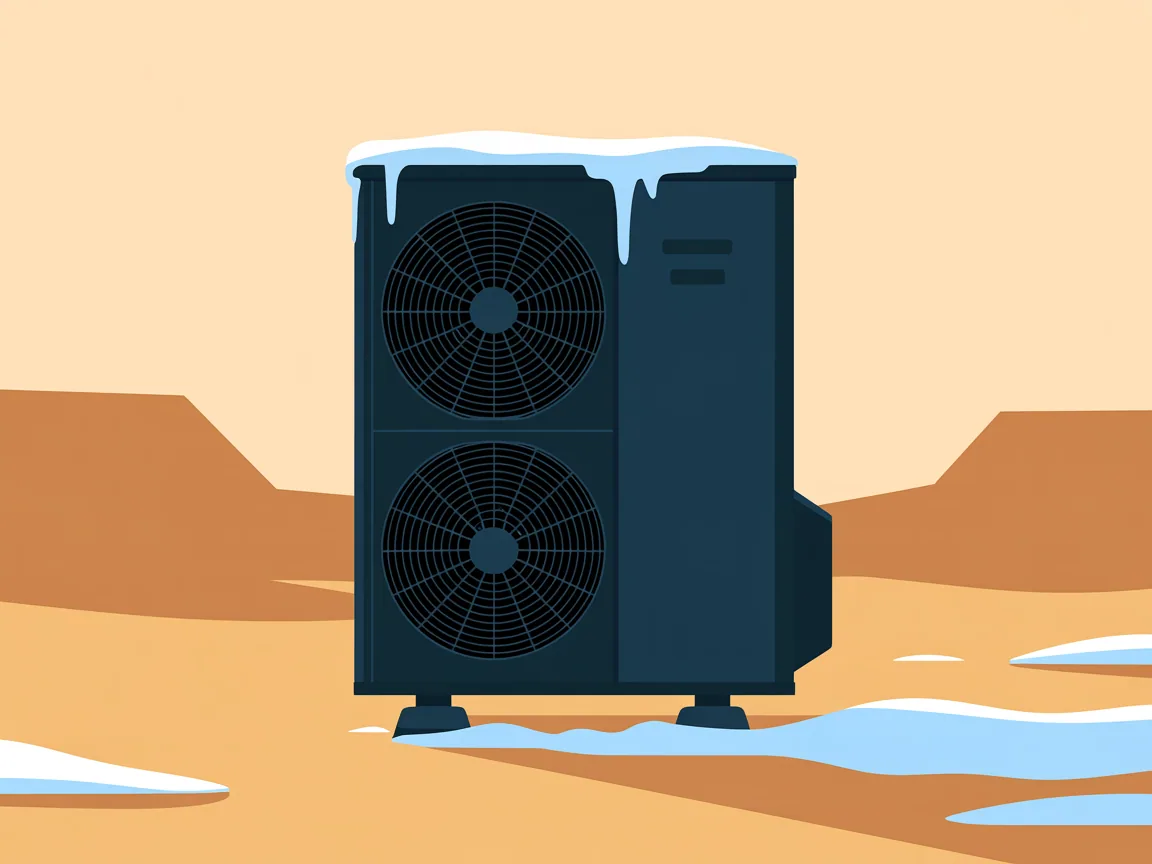
Describing the pattern out loud is faster than typing it, and it is what tells a technician which mode to test first.
(480) 969-3193Get it diagnosed
Say which mode failed, and when
“It cooled fine all summer and blows cool air now” and “it never cooled properly in August” send a technician to different parts of the same machine. Tell us which mode, and whether the indoor blower and outdoor unit run.
Cooling fault, or heating fault?
ROC #341937 · CR-39 air conditioning. Open 24 hours a day, 7 days a week. Settle timing on the call, or reach the number at the top of this page any hour.
Reading the symptom
What the report usually means
It cooled all summer and now will not heat
The shared cooling hardware has just proved itself over months of run time. That moves the question to the reversing valve, the defrost control, the supplementary heat, or the wiring that switches between modes.
Cool air from the vents during a heating cycle
Often a normal defrost cycle lasting a few minutes. It becomes a fault when it does not end, when it repeats more often than the weather explains, or when the air never warms between cycles.
The outdoor unit hums and nothing turns
An electrical picture rather than a refrigerant one, and identical to the same symptom on an air conditioner. The run capacitor gets measured against its printed rating before any motor is condemned.
It runs almost continuously in mild weather
Long run time against a small load points at charge, airflow or a fouled outdoor coil. Note the outdoor temperature and the time of day when it happens, because that detail narrows it quickly.
Ice on the outdoor unit that does not clear
Frost in heating mode is expected and should clear on a defrost cycle. Ice that persists through several cycles raises the defrost control, the coil sensor and the refrigerant charge.
It heats weakly on the coldest mornings only
Output falls as outdoor temperature drops, which is the cycle behaving normally. The measurable question is whether supplementary heat is engaging when it should and shutting off when it should.
How the diagnosis runs
Five steps to the mode that failed
Step 1
Establish which mode failed
Cooling and heating faults sit in different places on one machine. The season, the symptom, and what changed in the house narrow the inspection before any panel is opened.
Step 2
Confirm the system is being asked to run
Thermostat mode and setting, the low-voltage signal reaching the equipment, and whether a safety device such as a condensate float switch has already opened the circuit. Equipment not being asked to run has not necessarily failed.
Step 3
Measure the shared cooling hardware
Contactor, capacitor, motor current, airflow, coil condition and the readings taken at the refrigerant circuit. These are the same measurements an air conditioner needs, and they come before any heating-side conclusion.
Step 4
Test the heating-side additions
Whether the reversing valve actually shifts, whether the defrost control and its coil sensor read correctly, and whether supplementary heat energizes on demand. Verified in the mode that failed, not inferred from the other one.
Step 5
Report the findings, then authorize
The measured values, what they indicate, the proposed repair, and what stays unresolved, in writing, before the work begins.
The components, and how a quote reads them
What is shared, what is heat-pump only, and which work class it is
Two flags decide how a repair is scoped. Whether the part is shared with any air conditioner or specific to a heat pump, and whether the work sits outside the sealed refrigerant circuit or inside it. A swap outside the circuit is a different class of job from work that requires recovery, evacuation and a weighed charge.
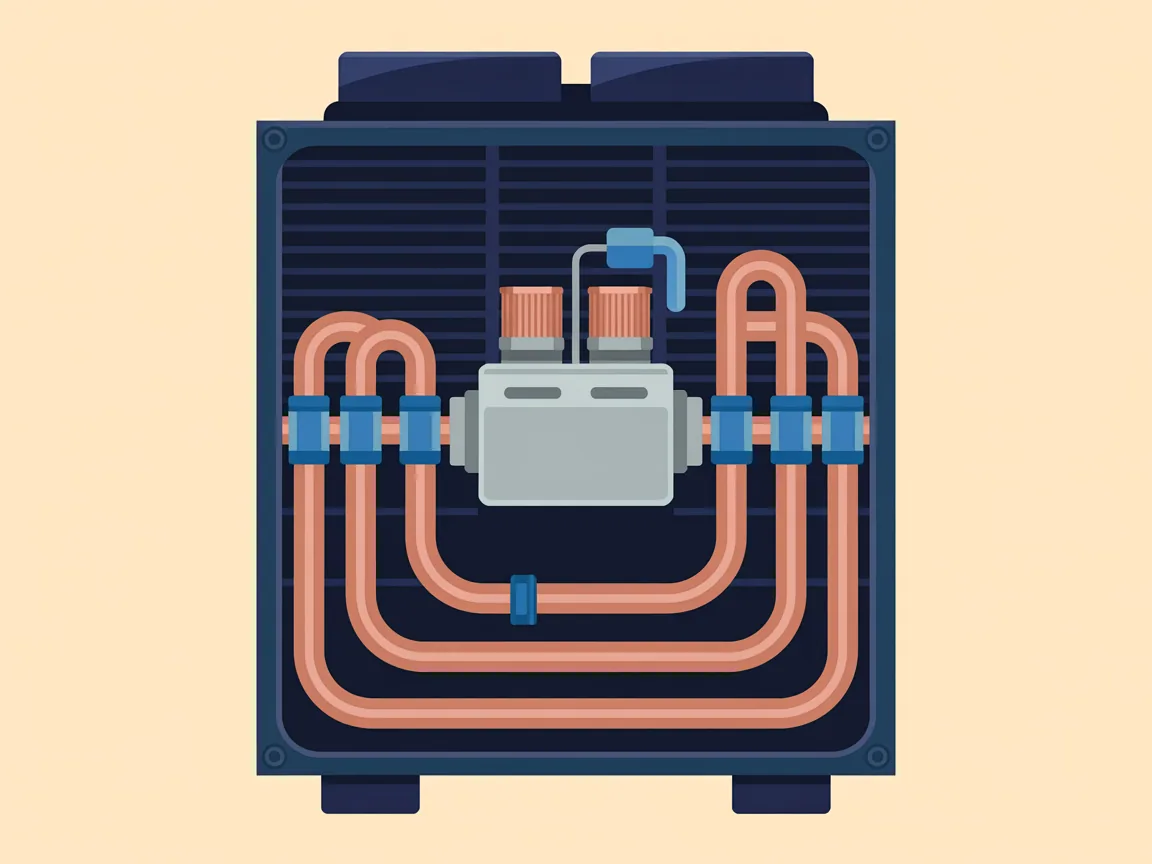
Shared with any air conditioner
Run capacitor and contactor
Outside the circuitShared with any air conditioner, and the most common electrical failures on either. A capacitor is rated in microfarads and in volts, and a replacement has to match the printed rating rather than come close to it.
Heat-pump only
Reversing valve
Sealed circuitThe component that makes a heat pump a heat pump. A solenoid shifts it between cooling and heating. A valve that will not shift, or shifts only partly, gives a system that cools normally and heats poorly.
Defrost control and coil sensor
Outside the circuitTogether they decide when the outdoor coil needs clearing in heating mode and when the cycle should end. A sensor reading the coil incorrectly produces defrost cycles that are too frequent, too long, or absent.
Supplementary electric heat
Outside the circuitResistance elements in the air handler that cover what the refrigeration cycle cannot. Rarely needed for long in this climate, which is exactly why a fault in that circuit goes unnoticed until a cold week arrives.
Sealed circuit repairs
Anything inside the refrigerant circuit involves recovery, repair, evacuation and a weighed charge. That is a different class of work from a component swap outside the circuit and should be scoped as such.
JB Water & Air provides heat pump repair in Mesa, AZ, and repairs, maintains and installs heating systems of all types, under Arizona air-conditioning license ROC #341937, classification CR-39. The company is family owned and has served the East Valley since 1981, and is open 24 hours a day, 7 days a week at (480) 969-3193. Settle a specific arrival time on the call.
In Mesa this is a cooling appliance for most of the year that also heats for a few weeks. Most of the wear happens in the season nobody calls about, and most of the calls arrive in the season with the fewest run hours.
A fault that shows only in cooling is read the way it is on any split system. The first useful split is whether the unit will not start at all or starts and never cools. A no-start points at the control signal, the contactor, the run capacitor, or a safety device that has opened deliberately. Running without cooling points at airflow, the coils, or the refrigerant charge. That reasoning is set out step by step on the AC repair page, and it applies to a heat pump without modification.
What Mesa conditions do to the equipment
Dust on the outdoor coil
The outdoor coil is the surface the whole cycle depends on, and it sits in the open. After a haboob it carries the fine caliche dust the Valley is built on, packed into the fins. In summer that raises head pressure and makes the compressor and its capacitor run hotter than they were designed to. In winter the same fouled coil is what the machine is trying to pull heat out of, so it produces longer run times and more frequent defrost. One neglected coil generates complaints in both seasons that sound like two unrelated problems.
Irrigation overspray and hard water
Sprinkler heads and misting lines leave mineral deposits on the fins as the water evaporates. Those deposits insulate the surface, and because they build over years nobody notices capacity that left slowly. A sprinkler aimed anywhere near the outdoor unit is worth moving.
Long cooling seasons and short heating ones
Run hours rather than calendar years age this equipment here, the argument made at length in how long AC units last in Arizona. A heat pump accumulates almost all of those hours cooling. The mild winter is also why the equipment suits the climate: the hours where supplementary electric heat genuinely carries the house are few, so the most expensive part to run is the part that runs least.
Older Mesa housing stock
Much of Mesa's housing predates the equipment now installed in it. Ducts run through attics that reach punishing temperatures by mid-afternoon, return air is often undersized for what has since been fitted, and the condensate path is frequently a long run to a discreet exterior point. All of it changes what a new system can deliver and what the existing one is working against.
What drives a heat pump quote
There is no useful single figure for a repair or a replacement, because the work ranges from swapping a commodity electrical part to replacing matched equipment and correcting the distribution it connects to. Beyond the class of work, these are what actually move a number:
- on a replacement, the calculated load for the house rather than the capacity stamped on the equipment being removed;
- the condition and sizing of the existing ducts, returns and condensate path;
- electrical capacity at the panel and disconnect, which carries more weight on a heat pump because supplementary heat is an electrical load; and
- access, since a rooftop package unit and a ground-level split system are not the same job.
A quote should itemize the diagnosis and the measurements it rests on, the part and its specification, the labor, any refrigerant handling, and what is excluded or left unresolved. The same discipline applied to planned work is set out in what changes the cost of AC maintenance in Mesa.
Repair, or replace
A failure is not automatically a replacement conversation. Age on its own is weaker evidence than most people expect, and a single isolated fault on equipment that is otherwise sound is usually a repair.
Where the comparison is genuinely open, ask for both paths scoped in writing. A replacement proposal should establish how capacity was calculated for this house, which indoor and outdoor models are paired and what that pairing is rated at, what happens to the existing ducts, returns and condensate path, the electrical work included, the line set route, permitting where it applies, and the startup measurements taken at the end. The AC installation and replacement guide covers that scope, and it reads the same for a heat pump with the heating-side controls added.
Brands are a starting point, not an answer
Equipment reaches Valley homes under names such as Trane, Daikin and Rheem, and a manufacturer is a reasonable place to start reading. It settles less than it appears to. Rated performance belongs to a specific indoor and outdoor combination rather than to the outdoor unit alone, so two proposals naming the same manufacturer can describe different equipment and different results. Those names appear here as examples of equipment types only. Which lines any contractor installs or services is a question to ask directly.
After the visit, and what to keep
JB's labor on the repair carries a two-year workmanship guarantee, which excludes normal wear, manufacturer defects and damage from outside causes; manufacturer coverage on parts is separate. After service, confirm what was repaired and what operating result was verified in the mode that failed. Keep the invoice with the equipment record, so the next diagnosis starts from history rather than memory. To describe a current symptom, call (480) 969-3193.
“able to recommend few more things about my heating pump”
Vikram Khandelwal · From a review naming a heating pump · Read it on Google: Vikram Khandelwal's review, opens in a new window
Questions people ask
Straight answers
Why does my heat pump blow cool air in winter?
- Usually a defrost cycle. Frost forms on the outdoor coil in heating mode, so the system reverses for a few minutes to clear it and the supply air goes cool. It becomes a fault when the cycle does not end, repeats far more often than the weather explains, or the air never warms between cycles. The three reads on this page walk through which one you are looking at.
Should I repair or replace a heat pump?
- Repair an isolated fault on equipment that is otherwise sound. Compare against replacement when a major component has failed and the rest is also worn, when repairs have repeated across different parts, when comfort problems the current design cannot fix are part of the picture, or when parts availability affects the decision. Ask for both paths in writing.
Can a heat pump replace an air conditioner?
- Often yes, and the cooling half of the job is identical, because it is the same machine running the same direction. The comparison is strongest where the house currently heats with electric resistance elements, since one system then covers both seasons. Where gas already heats the house, the answer usually turns on the furnace condition.
Does a heat pump need different maintenance from an air conditioner?
- Mostly the same work, with additions. The shared cooling side needs the same coil, filter, airflow and electrical checks that AC maintenance covers. A heat pump adds the reversing valve, the defrost control and its sensor, and the supplementary heat circuit, all of which sit idle for most of an Arizona year and are worth verifying before winter rather than during it.
Related heating & cooling services
More on heat pumps from the JB team
Get the heat pump diagnosed
Say which mode failed and when it started. JB answers the phone 24 hours a day, 7 days a week.