Drinking water at one tap
Reverse osmosis vs. whole-house water filtration in Mesa
Reverse osmosis treats one tap, the one you drink from. Whole-house filtration treats every tap from the main, and what you taste or see decides which.
- 4.9 · 580 Google reviews
- CR-77 licensedROC #260511 · CR-77
- Since 1981Family owned since 1981
- Open 24/7
Where each one sits
- Whole-house filtration sits where the main enters, so every tap gets it.
- Reverse osmosis sits under one sink and feeds the tap you drink from.
Three jobs reverse osmosis does not do
- Soften the house
- Disinfect a supply
- Repair a pipe
The categories that get confused
“Purer water” is four different jobs
Softening, filtration, reverse osmosis and distillation solve different problems, and the most expensive mistake in this category is buying one for a job another does. Here is what each one treats, where it installs, and what it does not do. The two marked drinking water are the ones this page is about.
Water softening
- Treats:
- Hardness (calcium and magnesium)
- Installs:
- Point of entry, whole property
- Does not:
- Not contaminant reduction. It controls scale, it does not change taste or remove a defined substance.
Whole-house filtration
- Treats:
- Particulate, chlorine, taste and odor, or a defined substance
- Installs:
- Point of entry, whole property
- Does not:
- Media are not interchangeable. Sediment, carbon and specialty applications are different jobs, not one filter.
Carbon at the tap
- Treats:
- Chlorine, taste and odor at one fixture
- Installs:
- Point of use, single tap
- Does not:
- Leaves dissolved salts and most dissolved metals in the water. No drain, no tank, no reject.
Reverse osmosis
Drinking water
- Treats:
- Dissolved material carbon alone does not
- Installs:
- Point of use, usually one tap
- Does not:
- Does not control scale and is not a disinfection step. Slow output, a storage tank and water to drain.
Distillation
Drinking water
- Treats:
- Dissolved material, by boiling and condensing vapor
- Installs:
- Point of use, at the unit
- Does not:
- A distinct method with its own output rate, energy use and cleaning burden. The trade JB started in.
Softening and whole-house filtration are point-of-entry work, and they have their own page: water treatment in Mesa.
The stage order is the design
An under-sink RO unit is a sequence, not a box
Each position protects the one after it. Step through the five stages and see what each one does, what it shields, and what fails when the order is broken.
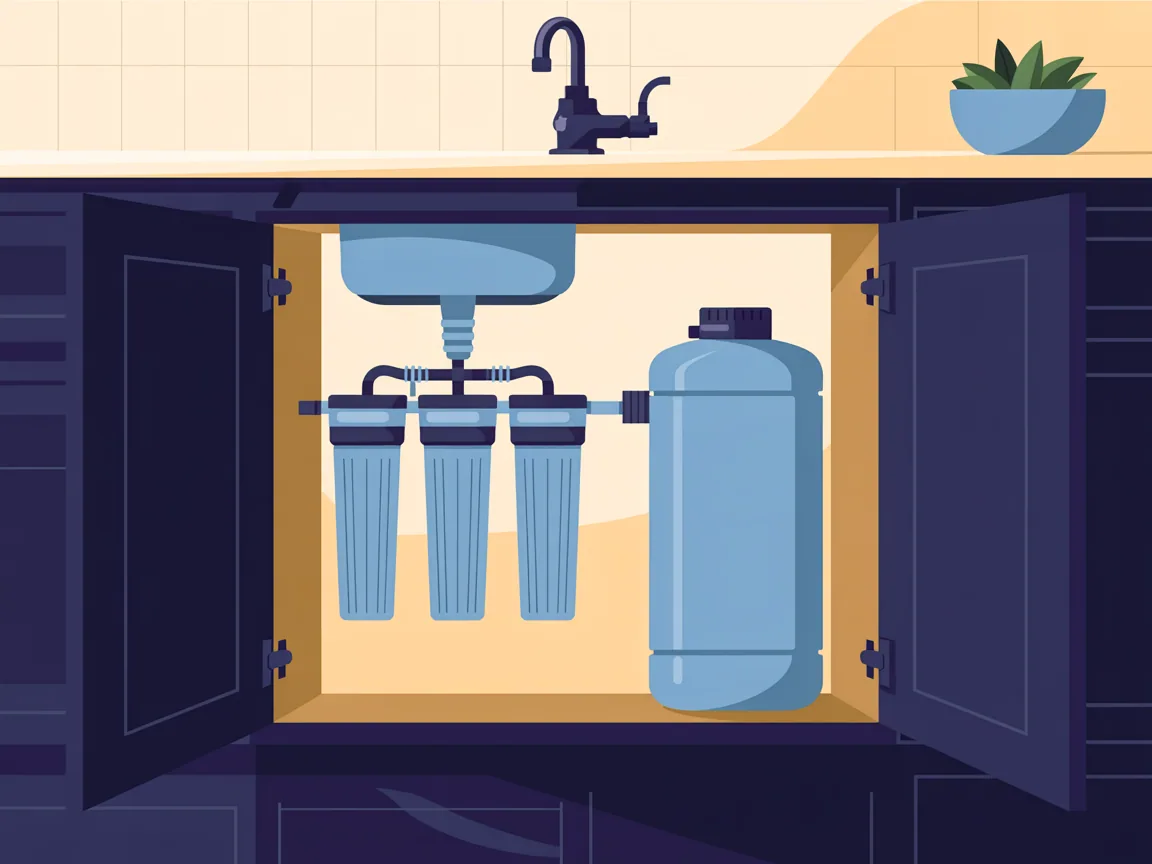
Stage 1 of 5
Sediment prefilter
Catches particulate and grit before anything else sees it.
What it protects. The carbon that follows, so it is not asked to do a sediment filter's job.
Break the order. Put carbon first and monsoon dust and fine grit load it early. It blinds and stops working long before its rated life, and every stage after it inherits the problem.
Saying which tap it is and what changed takes about thirty seconds out loud, and it is what decides whether this is a filter, a membrane or a plumbing question.
(480) 969-3193Describe the water, then choose the equipment
Tell us what you are tasting or seeing
Testing comes before equipment, and we will say what a test can and cannot establish. Send the details here, or call and describe it in your own words.
Which tap is it, and what changed?
ROC #260511 · CR-77 plumbing. Open 24 hours a day, 7 days a week.
How a system gets chosen
Four steps, in this order
Step 1
Test the water before anything is specified
Establish what is actually present at your own tap. Every later decision is downstream of this, and equipment chosen before a result is chosen against a guess.
Step 2
Decide which tap the problem is at
Drinking and cooking water is usually one fixture. Scale reaches every fixture, the dishwasher and the water heater. Where the concern shows up decides where the equipment goes.
Step 3
Match the model's data sheet to the result
A category capability and a documented model capability are two different claims. Read the manufacturer's performance data sheet for the exact model, line by line, against your own test.
Step 4
Record the starting readings, then the intervals
Log the installation date, the first readings and the replacement schedule. Without a baseline there is no way to tell drift from normal operation months later.
What you are seeing, and what to ask
Read the symptom before you buy the fix
The reverse osmosis faucet runs slow or sputters
The storage tank is not delivering, or a prefilter has loaded and is throttling production. Ask when the prefilters were last changed and whether the tank still holds its air charge.
Treated water starts tasting like untreated water
A stage has reached the end of its useful life, or a bypass has been left open. Ask whether a starting dissolved-solids reading was recorded at installation to compare today's reading against.
Spots on glassware continue after an RO tap is installed
Hardness was never treated. Point-of-use equipment at the kitchen sink does not touch the dishwasher supply. Ask whether the concern is scale or drinking water, because they are different installations.
White crust on shower glass, aerators and the hose bib
A hardness condition affecting the whole property, including the water heater. Ask what the hardness measures in grains per gallon before any equipment is specified.
Water is clear at the kitchen but rusty at one bathroom
The source is likely downstream of the meter, in a pipe or a fixture, rather than in the supply. Ask whether it clears after running and whether it appears on hot, cold or both.
The RO unit trickles to the drain continuously
The system is not shutting off when the tank is full, which sends water to drain around the clock. Ask how much reject water is expected during normal production and how that differs from a constant run.
Start with the water, not the equipment
Two Mesa realities that decide the install
The supply is a blend, and blends move
Mesa combines surface water from the Salt and Verde river system with Colorado River water delivered through the Central Arizona Project, plus groundwater. Which source dominates depends on the plant serving the address and on the season, so hardness and dissolved solids are a range for the city rather than one fixed figure. Read the utility's current consumer confidence report for the system serving your address before treating a general number as your number.
Slab houses set where equipment lands
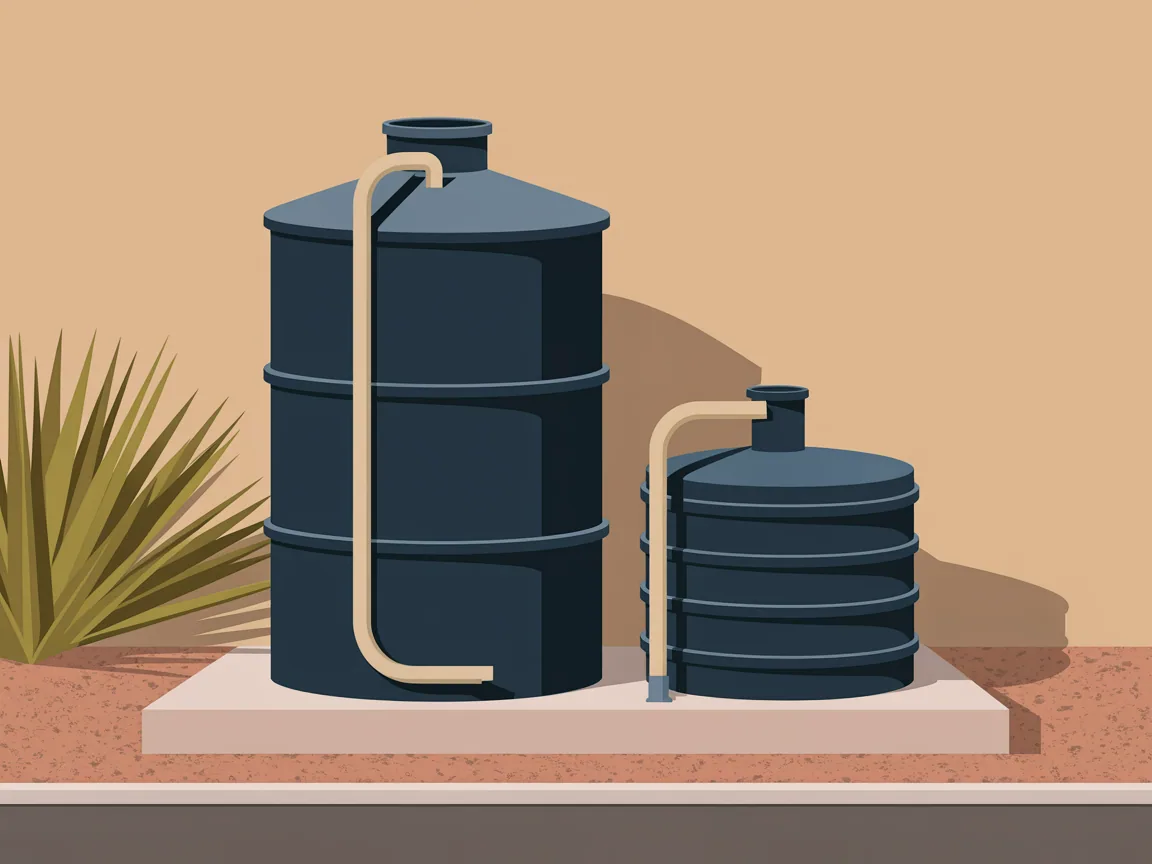
Most Mesa homes sit on slab-on-grade foundations, much of the newer stock post-tension, so there is no basement for point-of-entry equipment. It lands in the garage, on a side-yard pad or near the main, where July heat is hard on plastic housings and RO bladder tanks and monsoon dust loads a prefilter faster than its calendar suggested. Trenching runs into caliche, which is why an install is usually designed around existing accessible connection points rather than a preferred spot.
JB Water & Air installs and services drinking-water treatment in Mesa, AZ under Arizona plumbing license ROC #260511, classification CR-77, and has been family owned here since 1981. The phone is answered 24 hours a day, 7 days a week at (480) 969-3193.
This page is about the water you drink and cook with, treated at one tap. If the complaint is scale on the shower glass, spotting in the dishwasher, or a water heater filling with sediment, that is a whole-property problem and the water treatment page is the one you want. The two get bought the wrong way round often enough that the softener versus filter comparison exists to work through it.
What the membrane rejects, and what slips past
A reverse osmosis membrane separates largely by molecular size and charge, so it is the category generally documented for reducing dissolved salts and metal ions. That separation is not uniform. Dissolved gases such as carbon dioxide, and some small uncharged organic molecules, pass more readily than dissolved salts do.
That is exactly why carbon stages sit on both sides of the membrane instead of being sold as optional extras. One protects the membrane on the way in. The other handles what the membrane was never the right tool for on the way out.
None of that describes a specific unit, and it should not be read as a promise about one. A category capability and a documented model capability are two different claims, and only the second one is yours.
Test before you specify, not after
A hardness demonstration on a kitchen counter shows one property of the water, and a clear glass proves nothing about what is dissolved in it. Ask what a proposed water and air test measures, who performs it, whether independent laboratory analysis suits the question being asked, and what the result can and cannot establish.
Then read that result against the utility's own reporting for your address rather than against a figure quoted for the city as a whole. Equipment chosen before a result is chosen against a guess, and the guess is the expensive part.
What an under-sink install actually involves
Four things decide whether a system drops in or turns into a project. Whether the sink deck already has a spare hole for a dedicated faucet, or one has to be cut into the counter material you have. Where the reject line ties into the sink drain, and which arrangement the local jurisdiction accepts. Feed pressure at that fixture, since production across a membrane falls with it and a booster pump is sometimes the only route to a usable rate. And the run to the refrigerator, if the icemaker is meant to be fed too, which in a slab-built Mesa house means going through cabinets and walls rather than under the floor.
Then leave room to work. Filters have to be changed without emptying the cabinet first, because the unit that cannot be serviced comfortably is the unit that quietly stops being serviced. Treating water where it enters the property instead is a different conversation with its own whole-house considerations.
When the answer is not a drinking-water system
Three complaints arrive here regularly, and none of them is solved by a tap at the kitchen sink.
Spots and white crust are hardness, and hardness is treated where water enters the property. An RO faucet never touches the dishwasher, the shower door or the water heater, so the spotting continues exactly as before. The practical removal steps are in the guide to hard water stains.
Rusty water at one bathroom with clear water at the kitchen points at a pipe or a fixture rather than the supply. Filtering the kitchen tap hides that instead of resolving it, and hot-water symptoms belong with the water heater.
A contamination worry is a testing question before it is an equipment question. Residential systems are specified for water that is already microbiologically safe. They are not a substitute for a utility's treatment or for a boil-water notice. Start with the response guide for an Arizona water-quality concern.
Distillation, and why it is still on this page
A distiller boils water and condenses the vapor, which is a different method with its own output rate, energy use and cleaning burden. It is also where this company started, and distiller work still turns up by name in the reviews further down this page.
That matters practically rather than sentimentally. Distillers are a shrinking niche, so parts and service familiarity are worth asking any contractor about directly, and an owner weighing descaling an existing unit against moving to a membrane system deserves both paths described honestly. The comparison of reverse osmosis and distillation sets the two against each other on capacity, upkeep and running-cost drivers rather than on the word purity, which has no single technical definition.
After the install, what to keep
Keep the starting test result, the installation date and the equipment documents together, and record every filter, membrane and cleaning date against them. Without a baseline there is no way to tell drift from normal operation a year later, and the first useful question on any service call is what changed since it was working.
Use the replacement components the manufacturer specifies rather than the nearest cartridge that fits the housing. If taste, flow, drain behavior or refill speed changes, investigate rather than assuming the equipment is still doing what it did on day one. The archived RO filter exchange page explains how to verify current replacement service without implying that its prior promotion is still running.
JB's labor on water-treatment work carries a two-year workmanship guarantee: failed work is made right at no cost, excluding normal wear, manufacturer defects and damage from outside causes. Cartridges and equipment carry their own manufacturer terms, so keep that paperwork with the job documents. Where the concern is airborne rather than waterborne, indoor air quality is the separate question. To describe what you are tasting or seeing, call (480) 969-3193.

1981
Where the company began
John Bevell bought a distiller for his wife's health in 1981 and built a business around water. That history explains the company's long connection to water treatment.
It is company history, not evidence that one treatment method produces a medical outcome. Drinking-water and health questions belong with qualified health and public-water professionals.
“We rely on JB Water for our distiller's performance.”
Questions people ask
Straight answers
How does a reverse osmosis system work?
- Household pressure pushes water against a semipermeable membrane. Water passes through it, most dissolved material does not, and the rejected portion is flushed to the drain. A slow trickle of product water collects in a small storage tank so the dedicated faucet can deliver a glass at normal speed. Pressure, temperature and membrane condition all change the output rate.
Does a reverse osmosis system remove fluoride?
- Membrane treatment is the category typically documented for reducing fluoride, which is why carbon-only pitchers and refrigerator filters are not the comparison. Actual reduction depends on the specific system, feed pressure, water temperature and membrane condition. Ask for the manufacturer's performance data sheet for the exact model and compare it against your own test result rather than against a category claim.
What is the difference between reverse osmosis and distillation?
- Both produce treated drinking water by different means. Reverse osmosis pushes water through a membrane and is usually installed at a single tap. Distillation boils water and condenses the vapor. They differ in what they reduce, in output rate, in energy use, and in upkeep, so the choice follows from the specific concern rather than from a general idea of purity.
How much is a reverse osmosis system?
- No honest figure exists before the site is seen, because the drivers vary by home: the number of stages, whether a dedicated faucet and drain connection already exist, feed pressure and whether a booster is needed, the run length to a refrigerator, and whether softening is being combined with it. Ask for the consumables schedule itemized alongside the equipment.
What upkeep does a reverse osmosis system need?
- Prefilters on one interval, the membrane on a longer one, and the storage tank checked for its air charge. A distiller instead needs regular descaling. Performance depends on that upkeep being done on schedule, so the service interval and the replacement parts belong in the buying decision rather than being discovered a year later.
Related water & air services
Describe the water, then choose the equipment
Tell us which tap it is and what you are tasting or seeing. JB answers the phone 24 hours a day, 7 days a week.
ROC #260511 · CR-77 plumbing. Family owned in Mesa since 1981. 2-year workmanship guarantee on our labor, excluding normal wear, manufacturer defects and damage from outside causes.