Water Heaters6 min read
Mesa Water Heater Costs in 2026: Tank vs. Tankless Scope
Compare the work that drives tank and tankless water-heater installation costs in Mesa, plus the details every written quote should define.
By JB Water & Air · Published Jul 1, 2026 · Reviewed Sep 2, 2026
- 4.9 · 580 Google reviews
- CR-77 licensedROC #260511 · CR-77
- Open 24/7
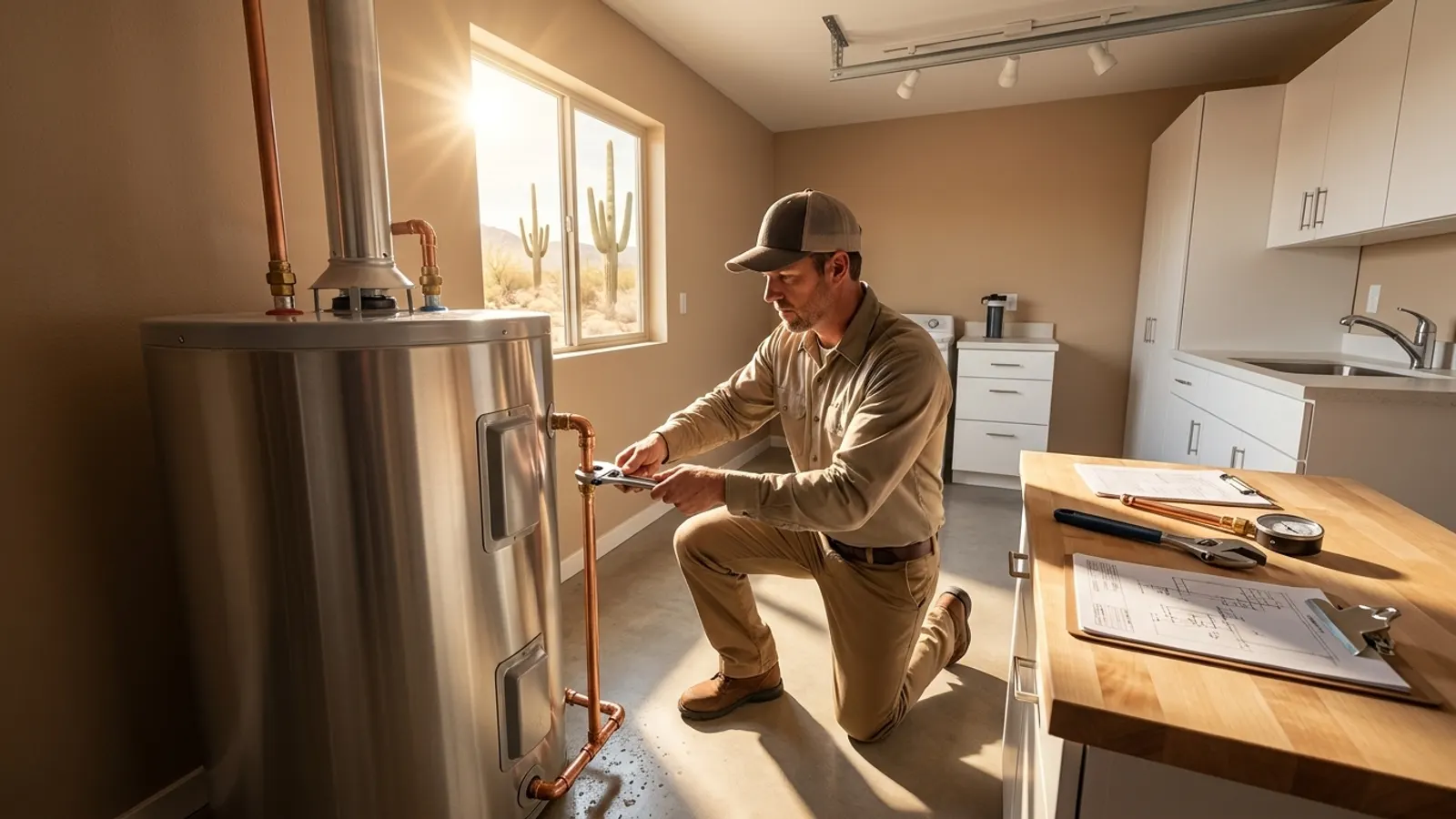
The honest answer to “What does a water heater cost in Mesa in 2026?” is that the equipment label is only one part of the installation. A straightforward tank replacement in a suitable location and a tank-to-tankless conversion with new gas, electrical, venting, condensate, and mounting work are not comparable scopes.
This guide does not publish an unsupported price range. Equipment availability, permit requirements, site conditions, and contractor pricing can change, and a web page cannot inspect the home. Instead, it shows what should appear in a useful quote and how the cost drivers differ between tank and tankless systems.
For a system-specific assessment, start with JB Water & Air’s water-heater service page and confirm the current scope directly.
First decide what “installed” includes
An advertised equipment price may omit delivery, removal, permit handling, connections, valves, drain-pan work, venting, gas or electrical changes, commissioning, and disposal. A contractor’s proposal may include some or all of those items. Comparing totals without comparing scope produces a misleading winner.
Ask each bidder to identify:
- the exact manufacturer and model;
- fuel type, capacity, and efficiency information;
- labor and installation materials included;
- permit and inspection responsibilities;
- required plumbing, gas, electrical, or vent changes;
- removal and disposal of the existing unit;
- startup, temperature setting, and functional checks;
- manufacturer warranty and contractor workmanship terms; and
- exclusions or conditions that could change the price.
Do not assume a phone description creates a final quote. Access, existing workmanship, corrosion, code issues, and hidden routing can change what is required.
Tank water heater: the usual cost drivers
A storage-tank heater keeps a volume of hot water ready for use. In many replacement projects, the broad layout already exists, but “same type” does not guarantee identical connections or a simple swap.
Capacity and recovery
The tank must fit the household’s hot-water pattern, available space, and fuel or electrical capacity. A larger tank is not automatically better. The appropriate choice considers simultaneous showers, tubs, laundry, dishwashing, temperature needs, and how quickly the unit recovers after demand.
Location and protection
Installation in a tight closet, attic, interior room, raised platform, or other difficult area can change labor and protection requirements. Drain pans, drain routing, seismic restraint, combustion-air conditions, and clearances may need evaluation based on the site and applicable requirements.
Connections and controls
Water connectors, shutoff valves, gas piping, electrical circuits, vent components, expansion control, and temperature-and-pressure relief discharge must be assessed rather than automatically reused. The technician should explain which items remain suitable and which need correction.
Tank units often have a lower conversion burden when they replace a compatible tank in the same location. That is not the same as promising the lowest lifetime cost or the easiest installation in every house.
Tankless water heater: where scope expands
A tankless unit heats water as it flows. It can provide long draws within its designed capacity, but it still has a maximum flow and temperature-rise capability. Sizing must consider the incoming water temperature and the fixtures expected to run at the same time.
Fuel and electrical demand
Gas tankless equipment may require a different gas supply than the existing tank. Electric tankless equipment can require substantial electrical capacity. A qualified contractor must evaluate the actual system; choosing a unit from a chart without checking the building services can lead to poor performance or an impractical conversion.
Venting and condensate
Venting category, route, termination, material, and manufacturer instructions matter. Some high-efficiency equipment also produces condensate that needs an appropriate disposal path and may require additional components. These are installation-scope items, not cosmetic add-ons.
Mounting, piping, and service access
Conversion can involve wall mounting, rerouting water lines, isolation or service valves, and clearance for maintenance. The proposal should show how the system can be flushed or serviced later. Mesa’s hard-water conditions make manufacturer-directed scale maintenance an important ownership question, but no universal interval fits every water condition and model.
Tank versus tankless: compare the household decision
The right choice is not simply “lower purchase price” versus “endless hot water.” Compare the following:
| Decision factor | Storage tank | Tankless |
|---|---|---|
| Delivery pattern | Stored volume plus recovery | Continuous heating within flow and temperature-rise limits |
| Conversion work | Often less when replacing a compatible tank | May require gas, electrical, vent, condensate, or piping changes |
| Space | Requires tank footprint and service clearances | Wall-mounted, with required clearances and service access |
| Maintenance | Inspection and manufacturer-directed tank care | Manufacturer-directed inspection and scale service |
| Outage behavior | Stored hot water may remain briefly, depending on condition | Usually cannot heat without its required utility supply |
| Best fit | Depends on demand, layout, budget, and existing services | Depends on demand, layout, budget, and existing services |
Energy-use projections should be based on the exact models, household use, and current utility rates. Avoid guaranteed savings or payback dates. A more efficient rating does not automatically recover a larger conversion cost within a specific number of years.
Mesa conditions that may affect the proposal
Local work can be influenced by hard-water scale, outdoor heat, installation location, existing plumbing, and the current permitting or inspection path. Those factors should be assessed at the address rather than converted into a generic “Mesa surcharge.”
JB Water & Air’s Mesa service page establishes the company’s local plumbing and water-treatment categories. It does not publish a universal water-heater price. Ask how observed scale or water quality changes the recommended equipment and maintenance plan, and whether a separate water-treatment option is relevant. A softener or filter should never be added merely as a sales assumption.
How to compare written proposals fairly
Put every proposal into the same checklist:
- Same performance target: Does each option address the household’s actual peak demand?
- Same installation boundary: Are gas, electrical, venting, valves, drain routing, and disposal treated consistently?
- Same permit responsibility: Who obtains permits and coordinates any required inspection?
- Same warranty categories: Separate equipment parts, manufacturer labor, and contractor workmanship.
- Same maintenance assumptions: Identify required service and the consequences of not performing it.
- Same change process: Ask how concealed conditions or added work will be documented and approved.
Financing, rebates, credits, promotions, and tax treatment can change and may have detailed eligibility rules. Treat them as unconfirmed until the provider or responsible program supplies current written terms. Do not let a possible incentive replace a complete installed-scope comparison.
Questions to bring to the assessment
- What caused the current unit to need replacement?
- Is repair still technically reasonable, and what remains old if it is repaired?
- Which tank or tankless model is proposed, and why does it fit demand?
- What existing components can remain, and what evidence supports that decision?
- Which site conditions could change the scope?
- What maintenance does the manufacturer require?
- What will be documented at startup?
JB Water & Air is family owned in Mesa and provides plumbing and water-treatment services across its published East Valley service area. To request a current, property-specific discussion, contact JB Water & Air with photos of the equipment label and installation area, the fuel type, current symptoms, and household hot-water needs. Final pricing and availability require direct confirmation; this guide intentionally does not invent them.