Commercial · Mesa & the East Valley
Commercial plumbing and HVAC in Mesa, around your hours
JB handles commercial plumbing and HVAC for Mesa businesses: rooftop units, shared drainage, tenant improvements and gas piping, with one point of contact.
- 4.9 · 580 Google reviews
- CR-77 & CR-39 licensed
- Since 1981Family owned since 1981
- Open 24/7
Before a number, the coordination
The wrench work overlaps. The coordination is the job.
The scope of commercial work is decided by access and timing as much as by the fault itself. Tell us the property and how it runs, and this maps what the job actually involves.

Tell us the property
Pick the property and how it runs, and this maps the four things a commercial job turns on here: the survey, the permit question, the work window, and the paperwork you are left with.
Reading the building
Patterns that point somewhere
One fixture misbehaving is a fixture. The same complaint arriving from several places at once is the building telling you where to look, and it is the most useful thing you can describe on the call.
Several restrooms on the same side of the building slow down in the same week
A branch shared by all of them is restricted, rather than any one fixture. The question is how far downstream that restriction sits, and whether anything upstream of it still drains normally.
Cooling holds overnight but falls away by mid afternoon in summer
Capacity is being met at low load and lost at peak load. The question is whether the limit is airflow, charge, a failing component, or a unit sized for how the space used to be occupied.
Pressure across the building drops whenever one piece of equipment runs
A single demand is taking more than the supply can hold at that point. The question is whether the constraint is the equipment, the line serving it, or a restriction shared with the rest of the building.
An odor returns in a tenant space after a weekend closure
The system is open somewhere it should be sealed, and a trap that dried out while nothing ran is the common reason. The question is whether that is all of it, or whether a floor drain or venting fault sits behind it.
Scale rebuilds on aerators, flush valves and coil surfaces within months
Minerals are depositing faster than the cleaning interval absorbs them. The question is whether the answer is a shorter interval or treatment upstream of the fixtures.
The same drain keeps appearing on the service log
Something at that location is holding material rather than passing it. The question is what a camera finds at the exact distance where the blockage keeps recurring.
When it is stopping trade
Start with the operational consequence, not the fixture. Open 24 hours a day, 7 days a week, so describe the impact on the call and timing gets settled there.
Water is running where it should not
Isolate at the nearest safe shutoff and keep people clear of wet electrical equipment.
Sewage is backing up
Stop water use in that area and keep staff and customers away from the contamination.
Cooling has failed in summer
Note which zones are down, and any space holding stock or occupants that cannot tolerate heat.
Record which areas and which tenants are affected while it is happening. Emergency plumbing guidance covers what to do for anything actively damaging the property.
What is in these buildings
The specification decides itself, once you look
Original cast iron drainage
Common in older Mesa buildings. It lasts a long time and then fails from the inside out, so the useful question is not its age but its remaining wall thickness and how much of the bore is now scale. Inspection settles that, and it decides repair against replacement.
PVC and no hub cast iron for replacement drainage
PVC is light and simple to route. No hub cast iron is quieter and behaves differently inside a fire rated assembly. In a multi tenant building with occupied space above, noise transmission and the assembly rating usually decide it rather than the pipe itself.
Copper and PEX for domestic water
Copper is rigid, long established, and serviceable by any plumbing trade. PEX runs with fewer joints and tolerates movement. Route, existing material, and whether the run stays accessible after the ceiling closes generally decide which is appropriate.
Packaged rooftop units and split systems
Packaged units put the equipment on the roof, which keeps tenant space clear but puts service access and dust exposure up there too. Split systems divide the equipment, which suits zoned interiors but needs indoor space and a refrigerant route. Building layout and access rules usually decide it.
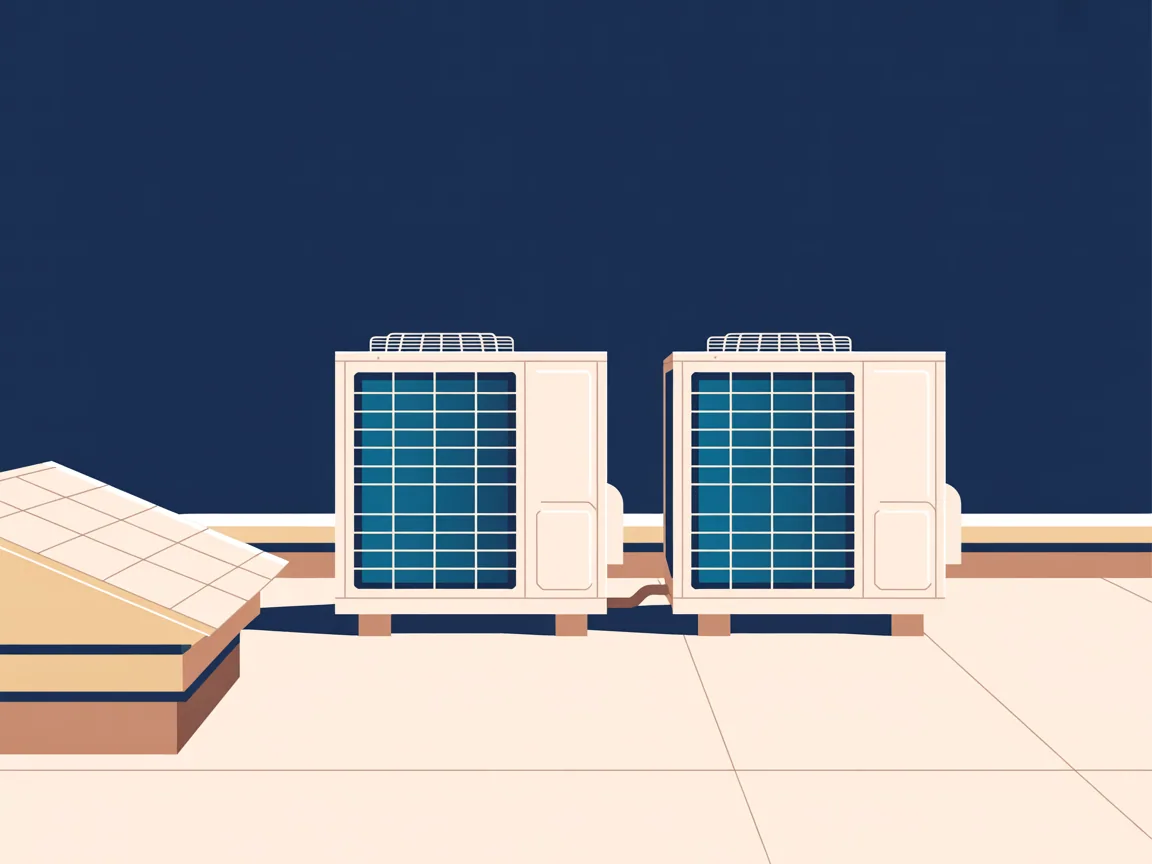
JB Water & Air services commercial plumbing and HVAC across Mesa and the East Valley, and has worked the Valley since 1981. The plumbing scope falls under Arizona ROC #260511, CR-77. The air conditioning scope falls under Arizona ROC #341937, CR-39.
The company is open 24 hours a day, 7 days a week, which is not a promise of a specific arrival time. Timing is settled on the call at (480) 969-3193.
Who authorizes the work, and where responsibility changes hands
Residential work usually has one decision maker in the room. Commercial work has an owner, a manager, a tenant whose lease assigns some systems to them, and a utility that owns everything past a defined point. Establish who authorizes work and where responsibility changes hands before a scope is written, because that boundary decides whose repair it is. Where sewer responsibility splits sets out the usual dividing line.
Permitting sets the sequence for the same reason. An inspection that has to happen before a wall or a trench closes decides the order of the work and the number of visits, and finding that out late turns one shutdown into two.
Commercial plumbing services
Leak and pipe evaluation
Commercial piping crosses tenant boundaries, service rooms, ceilings and exterior ground. Before finishes are opened, separate the visible symptom from the likely source. One damaged section may be repairable. A repeating pattern across the system argues for a replacement plan instead. The Mesa plumbing services hub lists the pipe, leak, sewer and fixture categories.
Drain and sewer service
One blocked fixture and a building wide drainage problem call for different responses. How many fixtures are affected, how they relate to each other, and how often the problem repeats point toward clearing, jetting, camera inspection or repair. How to tell whether the main line is clogged describes the pattern to look for.
Staff will usually try something first. Baking soda and vinegar make a fizz that does not travel far past the trap, carries no force, and does nothing to grease, scale or roots further down, which is why the remedy fails on anything structural. A building with a kitchen does better on a planned interval than on reaction, and how often drains need professional cleaning covers how that interval is set.
Water heaters and hot water systems
Commercial hot water demand follows occupancy and use. A useful evaluation weighs the symptom, the equipment condition, the recovery requirement, the existing gas or electrical service, and the space available. Size the replacement to the site's demand, not to the model number that came out.
Fixtures and tenant improvements
Fixture work involves shutoffs, supply and drainage connections, clearances, accessibility requirements and coordination with other trades. Settle who supplies the fixture, what existing conditions the scope includes, and who restores the adjacent finishes.
Gas piping
Adding or moving gas fired equipment means reviewing appliance demand, line sizing, route, shutoffs, testing, permits and inspection. Gas line work in Mesa sets out what should be resolved before equipment is connected.
Commercial HVAC services
Repair
A diagnosis should separate an isolated component fault from an airflow, control, electrical or capacity problem, because those carry very different scopes and schedules. Say which zones are affected, whether the equipment runs at all, and what the controls display.
Maintenance
Maintenance earns its place when it is tied to an equipment inventory and a repeatable scope. A property decision maker should know which units are covered, what is inspected on each, which readings are recorded, and how urgent findings are separated from capital plan items. Without that inventory, no two years of service can be compared.
Replacement and installation
Age alone is a weak reason to replace. Run hours, repair history, air distribution, controls, electrical or gas requirements, roof access and business disruption all belong in the decision, and how long AC units last in Arizona explains why desert run hours shorten a service life. The Mesa HVAC services page covers the categories.
Arizona conditions that shape a commercial scope
Hard water, multiplied by the fixture count
Mesa's supply blends Colorado River water delivered through the Central Arizona Project with Salt and Verde river water and groundwater, and it arrives hard. Hardness is normally quoted in grains per gallon, and the city publishes its own figures each year. A building with dozens of fixtures carries the resulting scale dozens of times over, which is why a cleaning interval borrowed from a house does not hold in a building. What Mesa hard water actually means separates what it does from what it does not.
Monsoon dust and rooftop equipment
Haboob dust loads filters and coil faces faster than a standard service interval expects, and it arrives in the months the equipment runs hardest. Check condensate lines and roof drains before storm season rather than after the first storm, because a blocked condensate line finds the occupied ceiling below it.
Caliche, slabs and post-tension
Underground work outside the building runs into caliche, a cemented hardpan layer that slows excavation and changes both duration and surface restoration. Inside, a slab cut has to account for what is in the slab. Plenty of East Valley commercial construction sits on post-tension foundations, where steel cables run under tension through the concrete, so the slab gets scanned and marked before anything is cut. Ask how that is handled before a below slab scope is treated as firm.
What a decision-useful quote should contain
A commercial quote should name the observed problem, the proposed scope, the access assumptions it relies on, the exclusions, and how completion will be verified. For a repair, ask whether it is a permanent correction or a stabilizing step. For a replacement, ask what evidence makes replacement better than repair.
Agree in advance how changed conditions get handled, because concealed damage, inaccessible piping and undocumented alterations surface after work starts. On completion, ask for a record of what was done, what was tested, and what was deliberately left for later. That record is what the property file still needs years from now.
Talk about the property
Start with a site survey
Tell us the site and the documentation you need We will confirm access, the permit question and a window on the survey, not before.
A call is faster than this form for anything affecting trade: (480) 969-3193. ROC #260511 · ROC #341937 · CR-77 plumbing & CR-39 air conditioning.
Questions people ask
Commercial, answered plainly
What is commercial plumbing?
- Commercial plumbing is work on the water, drainage and gas systems of a building used for business rather than as a home. The systems are larger, shared between tenants, and governed by the building's own access and permitting rules. In Mesa and the East Valley that usually means multi tenant retail, restaurants, offices and medical suites rather than industrial process piping.
What is the difference between commercial and residential plumbing?
- The differences are scale, ownership and consequence. Commercial systems serve more fixtures on longer runs, responsibility is often split between an owner, a tenant and a utility, and a failure interrupts trading rather than a household. Permitting thresholds are crossed more often, and work is scheduled around business hours instead of around a family.
What is commercial HVAC?
- Commercial HVAC is the heating, cooling and air handling equipment that conditions a business property, commonly packaged rooftop units or split systems serving defined zones. It is specified against occupancy, internal heat load and how the space is actually used rather than against floor area alone, and it is serviced against an equipment inventory rather than one unit at a time.
What is the difference between commercial and residential HVAC?
- Commercial HVAC runs longer hours against a heavier and more variable load, and it is usually zoned. Equipment tends to sit on the roof rather than beside the building, which changes access, safety and dust exposure. Controls are more involved, and a failure affects tenants and stock rather than one household, so replacement is planned rather than reactive.
Can a business report an issue after normal hours?
- JB Water & Air is open 24 hours a day, 7 days a week. That is not a promise of a dispatch, arrival or completion time. Out of hours, the details that matter most are who is on site and authorized to approve work, and how the building is entered after close, because access is usually what decides when anything can begin. Call (480) 969-3193.
What should a property manager send before the visit?
- Send the service address, the on site contact authorized to approve work, the affected equipment or fixtures, the operational impact, the access and check in rules, and any prior reports or repair history. Photographs help describe a condition. They do not replace an inspection, and no final diagnosis or firm scope should be built on them.
How do we request commercial service?
- Call (480) 969-3193 or use the contact page. Describe the business impact, name the on site contact, and say whether water, sewage, gas, electrical equipment or indoor temperature is creating an immediate safety concern. If access is restricted to particular hours or needs a check in process, say so on the first call.
Talk about the property
Commercial work carries different access, scheduling and paperwork. Call and describe the site, or send the details for a survey.