
Main water line · Mesa, AZ
Water line repair in Mesa, from the meter to the house
We repair and replace Mesa water lines, the buried pipe from your meter to the house. One meter test shows whether that line is leaking before anyone digs.
- 4.9 · 580 Google reviews
- CR-77 licensedROC #260511 · CR-77
- Since 1981Family owned since 1981
- Open 24/7
In one line
Water line repair addresses a leak or restriction on the single buried pipe carrying water from the meter to the property, and replacement becomes the better comparison when the damage runs along the line rather than sitting at one located point.
What you are seeing, and the question it raises
Six signs, and what each one narrows to
The low-flow indicator moves with everything off
Water is leaving the system somewhere. The question is which side of the house valve it is on, because that one test separates a buried service line from a leak under the slab.
A patch of yard stays damp in dry weather
Water is surfacing after leaving the pipe underground. The question is where the line actually failed, because caliche can carry water sideways before it finds a way up.
Pressure holds until a second fixture opens
The supply is delivering pressure but not volume, which points at a restriction. The question is whether that restriction sits in the buried line or inside the house.
Pressure has fallen across the whole property
A drop at every fixture points at the supply rather than at one valve, fixture or appliance. The question is whether it fell suddenly or crept down over years, because those have different causes.
The bill stepped up with no change in use
A supply-side loss runs continuously, so it shows as a step rather than a gradual climb. The question is what the meter reads over a closed interval with the property isolated.
Water is standing in the meter box
Something is leaking at or near the meter. The question is which side of it, because the boundary between the utility's pipe and the property owner's usually sits right there.
The test that comes before the shovel
Is the loss on the buried line, or past the house valve?
This is the one diagnostic that separates a buried service line from a leak under the slab, and it is the reason to read the meter before anyone opens the ground. Walk it through.
- 1Isolate
- 2Read twice
- 3Split at the valve
Isolate the property first
A meter reading taken while something is still drawing water proves nothing, and this is the step most often skipped. Confirm each of these is true before you read anything.
A steady face is the goal, but a slow loss can still show across an interval.
Illustration of a typical meter face. It is not a reading of your meter.
Water Line Repair in Mesa, AZ
The water service line is the one buried pipe between the meter at the street and the point where water enters the house. Nothing else in the plumbing system can compensate when it fails. JB Water & Air provides water line evaluation, repair, replacement, and installation in Mesa under Arizona CR-77 plumbing license ROC #260511.
If water is surfacing under pressure or running toward the structure, close the property's main shutoff when it is safe and you know which valve controls the line, and stay out of standing water near electrical equipment. Knowing which shutoff controls what is the difference between stopping a leak and closing the wrong valve. For an active break, use the emergency plumbing page. JB Water & Air is open 24 hours a day, 7 days a week, though arrival timing still has to be confirmed on the call.
When the Complaint Is Pressure
Static pressure and pressure under flow are different measurements
A gauge on a hose bib reads static pressure with nothing running. A restricted service line often reads acceptable static pressure and then collapses the moment a second fixture opens, because the restriction limits volume rather than pressure. If the shower fades when the washing machine fills but the gauge looks normal, the supply needs testing under flow, not at rest.
Whole property, or one fixture
Establish the scope of the complaint before blaming the buried line. One weak faucet is usually a fixture problem. Mesa's blended Colorado River and Salt River Project supply carries enough hardness, measured in grains per gallon, that scale collects at aerators, cartridges, and screens first. The Mesa hard water guide explains how hardness is reported and why it is not one fixed figure across the city.
A drop across the whole property points at the supply: a failing pressure regulator, a partly closed valve, a meter or utility condition, or the line itself. Galvanized steel service lines, still in the ground at plenty of older Mesa addresses, corrode and scale inward until the bore narrows. That produces gradual flow loss with no leak at all, and it is the case where whole-home repiping gets weighed against replacing the service line.
Repair the Section, or Replace the Run
A focused repair is defensible when the damage is confined to one located point, the pipe either side of it is sound, and access is practical. The proposal should say where the repair is, how the pipe will be reached, and what remains on both sides of it.
Replacement earns comparison when failures repeat along the same line, when the material has degraded along its length rather than at a point, or when the route makes returning for the next hole impractical. A replacement scope should name its endpoints, meter to building entry for example, rather than saying "new water line." An interior pipe replacement and an exterior service replacement are different work, with different permit, access, and restoration consequences.
What Drives the Quote
Ask every bidder to itemize:
- the located position and depth of the failure, and what located it;
- the segment being repaired or replaced, by endpoints, with pipe material and size;
- the method, and why the condition found supports it;
- access points or trench line, and what surface sits over them;
- utility locates and any coordination required;
- permit and inspection responsibility;
- pressure testing and disinfection before the line returns to service; and
- restoration of turf, granite, pavers, concrete, or curb, with the boundaries stated.
Two proposals only compare when those scopes match. One can read lower simply because it replaces less line, or because concrete and landscaping restoration sits outside it. How to choose a Mesa plumber covers verifying the license and reading proposals against each other.
How the source gets narrowed
Isolate, read twice, split, then locate
Isolate the property before reading anything
Close the fixtures, stop any appliance mid cycle, switch the irrigation controller off rather than waiting for its schedule, and close the pool autofill. A meter reading taken while something is still drawing water proves nothing, and this is the step most often skipped.
Read the meter, then read it again
The low-flow indicator catches a live loss. The odometer figure across a closed interval catches a slow one. Take both, because a leak too small to turn the indicator still shows up as a difference over time.
Close the house valve and watch the meter
This splits the system at a known point. Movement with the valve closed puts the loss between the meter and that valve, which is the buried service line. No movement puts it inside or beneath the house, which is a different investigation entirely.
Locate before any ground is opened
A wet spot is evidence, not a position. Tracing the route and pinpointing the failure is what sets where the ground gets opened and how much of it, and it is what turns a recommendation into a scope with endpoints.
Where it shows, versus where it broke
The wet patch is evidence, not a position
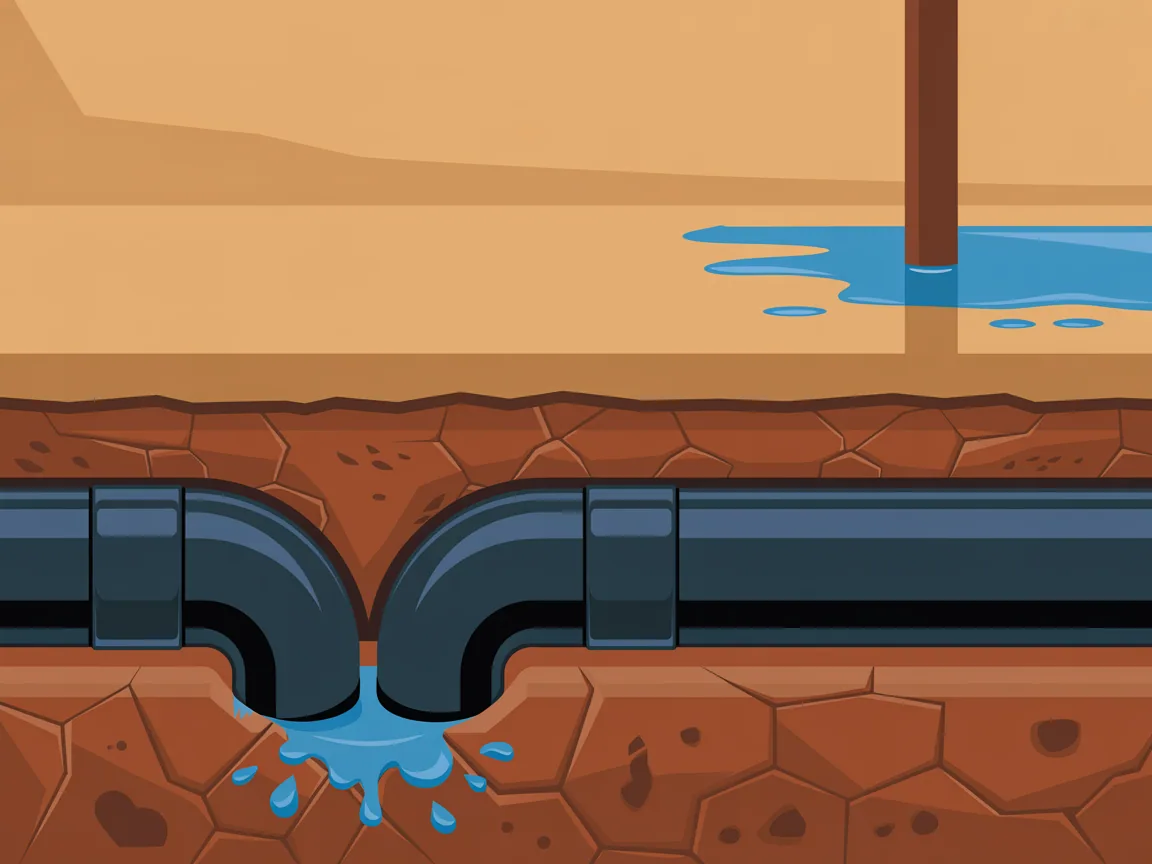
Much of Mesa sits over caliche, a cemented hardpan that water passes through slowly. Water escaping a buried line often ponds on that layer and travels sideways before it finds a way up, so it can surface well downhill of the failure, or at a driveway edge where the surface is already broken.
Digging at the wet spot is how one repair becomes several holes. Tracing the route and pinpointing the failure is what sets where the ground gets opened, and how much of it. Read the ground in a dry month, when days-long damp with the irrigation off is a real signal rather than monsoon runoff.
What the line is made of
The material changes how it fails
Galvanized steel
Found on older Mesa properties. It corrodes and scales from the inside, so the bore narrows over decades. The complaint is usually falling flow with no leak anywhere, and a spot repair leaves the rest of the narrowed run in the ground.
Copper
Long serving and rigid, joined with soldered or flared fittings. Its failures tend to be pinholes or a single joint rather than the whole length, which is what can make a located sectional repair worth comparing against a full replacement.
Polyethylene, PE and HDPE
Flexible, corrosion proof and supplied in long coils, so a new run can reach from the meter to the house with no buried joints. It is what pipe bursting pulls in. It needs a tracer wire, because plastic cannot be found magnetically by whoever digs next.
PEX
Also flexible and continuous across a run, and used for some service replacements. It is sensitive to sunlight, so it cannot be left exposed above ground at the meter or the building entry without protection.
Open trench, bored route, or pipe bursting
Trenchless does not mean no digging
On a residential water service, both trenchless methods still need an opening at each end. Lining, the method familiar from sewer work, is not the standard answer on a small pressurized potable line. What the route allows decides more than the label.
Open trench
- Needs
- A continuous excavated line along the whole route.
- Compares well when
- An open run through soft ground with nothing important over the top.
- How it works
- Excavation and restoration carry the scope.
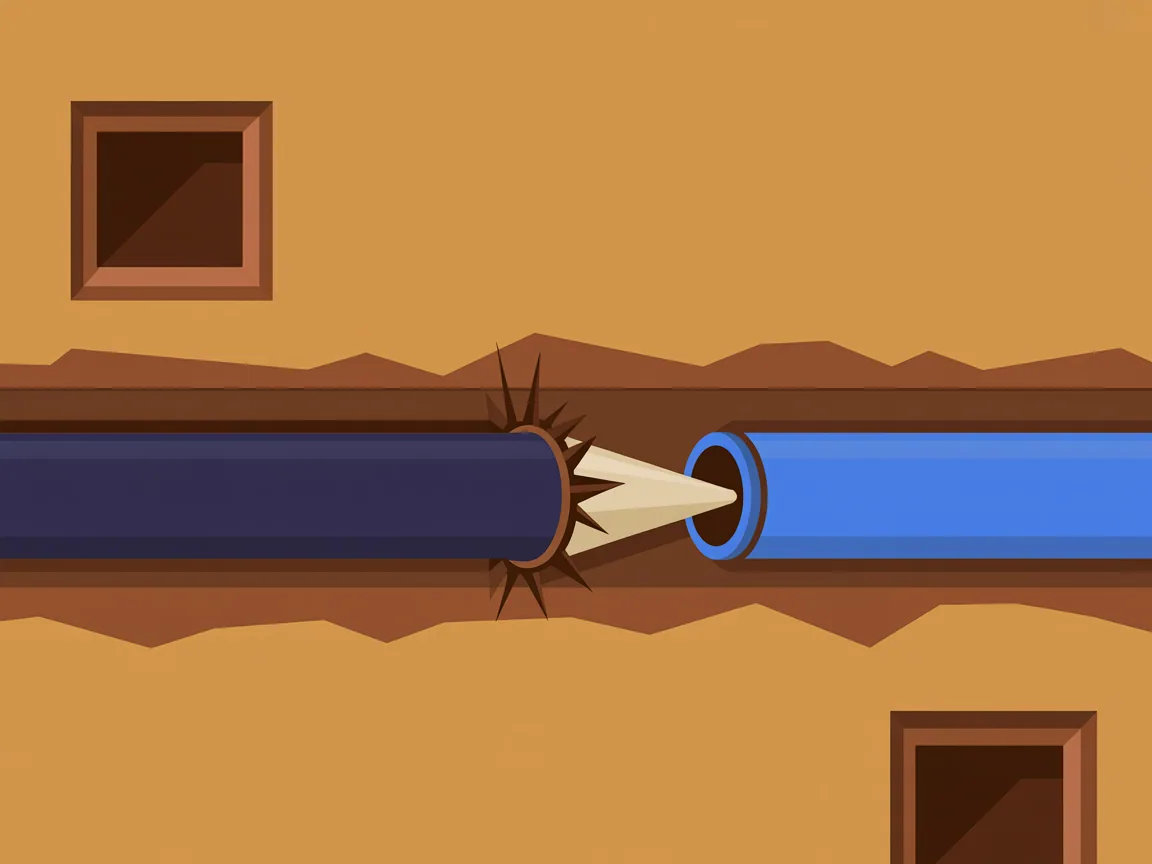
Pipe bursting
- Needs
- An access pit at each end and a route clear of crossing utilities.
- Compares well when
- A driveway, hardscape or mature landscaping sitting over the route.
- How it works
- A new fused polyethylene pipe is pulled while a head breaks the old one outward.
Bored route
- Needs
- A pit at the meter and a pit at the house for a fresh path.
- Compares well when
- Where a straight trench would cut through concrete or a driveway.
- How it works
- Method and access carry the scope instead of a long open cut.
Caliche decides more of this locally than anything else. It slows excavation and can push a deeper line into heavier equipment, which is why a bored route around a driveway sometimes reads better than a trench straight through it. Compare the two as complete scopes, with restoration included in both.
Whose pipe is it
The boundary usually sits at the meter
Responsibility usually changes at the meter, with the utility on the street side and the property owner for the line running from there to the house. The exact boundary is set locally rather than universally, so confirm it with the water provider before any excavation is authorized. It decides which side of the meter the work belongs on.
One thing that blurs the split test: on many Valley properties the irrigation tees off ahead of the house valve, which puts it on the same side of the split as the service line. Confirm where that tee sits before reading a moving meter as proof of a buried leak.
Request service
Tell us what the meter is doing
Share what the meter does with the property isolated, what it does with the house valve closed, any pressure change and whether it affects every fixture, and where the ground is wet. That is what narrows the source before anyone arrives.
Is the meter moving with everything off?
For an active break, use the emergency plumbing page. JB is open 24 hours a day, 7 days a week, though arrival timing still has to be confirmed on the call.
Questions people ask
Straight answers
How much does a main water line replacement cost?
- Nobody can price a service line from symptoms alone. The quote is driven by the length and depth of the run, whether the ground over it is soil, granite, turf, pavers or concrete, how hard the caliche is to open, the pipe material and size, the method the route allows, utility locates, permit and inspection, testing, and how much surface has to be restored. Ask for those itemized separately.
What is trenchless water line replacement?
- It is replacing the service line through defined access points instead of a continuous open trench. On a residential water service that usually means bursting the old pipe outward while a new fused polyethylene pipe is pulled along the same route, or boring a fresh route between a pit at the meter and a pit at the house. Both still need an opening at each end.
Does homeowners insurance cover main water line replacement?
- It depends on the policy and the cause. Many policies handle the buried service line differently from the water damage that results, and treat sudden accidental failure differently from gradual deterioration. Separate service line endorsements exist. Read the wording, document the failure before it is covered over, and speak to the insurer before authorizing work.
Is trenchless water line replacement cheaper than digging?
- Not automatically. Trenchless moves scope out of excavation and restoration and into method and access, so it tends to compare well where a driveway, hardscape or mature landscaping sits over the route, and less well on an open run through soft ground. Compare the two as complete scopes, with restoration included in both.
What is pipe bursting water line replacement?
- Pipe bursting pulls a new pipe along the existing route while a bursting head breaks the old one outward into the surrounding soil. It needs an access pit at each end and a route clear of obstructions and crossing utilities. The result is normally continuous polyethylene with no buried joints along the run.
Does a high water bill prove the main line is leaking?
- No. It shows that measured use went up. Irrigation, a running toilet, an interior leak, a slab leak or an actual change in consumption can all do the same thing. Isolate the property, read the meter over a closed interval, then close the house valve and read it again. That sequence is what narrows the source.
Who is responsible for the water line, the city or the homeowner?
- The split usually falls at the meter, with the utility responsible for its side and the property owner for the line running from there to the house. The exact boundary is set locally rather than universally, so confirm it with the water provider before excavation is authorized. It decides which side of the meter the work belongs on.
How do I request water-line service?
- Call (480) 969-3193 or use the contact page. Share what the meter does with the property isolated, what it does with the house valve closed, any pressure change and whether it affects every fixture, where the ground is wet, and any history of repair along the line.
Related plumbing services
More on water lines from the JB team
Check the main water line
A meter that keeps turning with every fixture closed is the clearest sign worth a call.