
Pipe replacement · Mesa, AZ
Pipe replacement in Mesa, only the section that failed
When one line keeps leaking, we replace that section between two fittings you can point at and leave the rest of your plumbing in service.
- 4.9 · 580 Google reviews
- CR-77 licensedROC #260511 · CR-77
- Since 1981Family owned since 1981
- 2-year labor guarantee2-year workmanship guarantee
Guarantee covers JB's own labor. Excludes normal wear, manufacturer defects and outside damage.
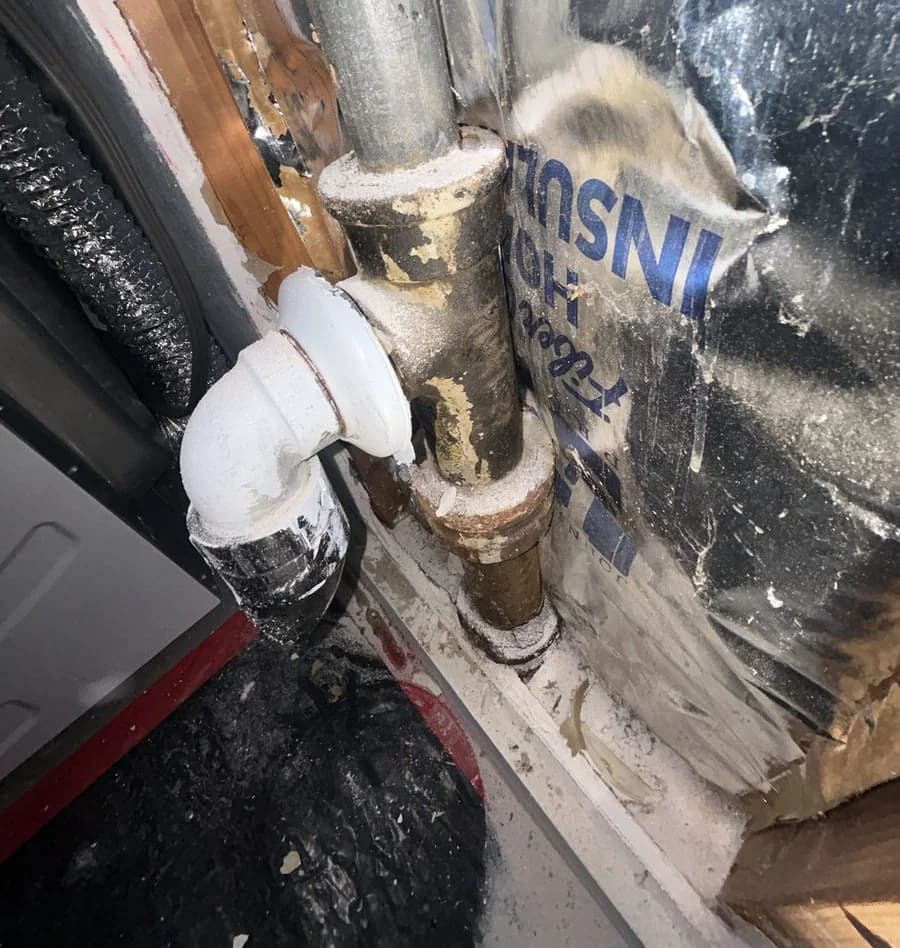
What pipe replacement is
Pipe replacement removes a defined run of failed or corroded plumbing pipe between two stated endpoints and connects new pipe to sections verified as sound, rather than patching one spot or replacing the whole system.
Write the boundary
An endpoint is a fitting you can point at
A scope is a boundary, not a description. How many repairs has this pipe already had? Set two endpoints and watch the scope sentence build.
The scope sentence this builds
“Replace the run from a tee in the run to the stub-out behind a fixture, in copper, 3/4 in.”
Both ends name a fitting a plumber can put a hand on, so two proposals can be compared in the same sentence. If a quote cannot be written this plainly, the run has not been diagnosed yet.
Tell us the leak history on that line and we will say whether it reads as a repair, a section, or something larger. Open 24 hours a day, 7 days a week.
(480) 969-3193Pipe Replacement in Mesa, AZ
Pipe replacement sits between two other jobs. It is broader than one pipe repair, which corrects a single failed spot on otherwise sound pipe, and narrower than a whole home repipe, which treats the distribution system end to end. JB Water & Air performs pipe replacement for Mesa properties under Arizona CR-77 plumbing license ROC #260511.
The useful question is not how old the pipe is. It is whether one defined run has stopped being a dependable repair candidate. A quote should name that run, say why a focused repair was rejected, and say what stays in service afterward.
When Replacement Beats Another Repair
A pipe earns replacement when the evidence describes a run rather than a point. Corrosion that leaves no sound material to connect to, a split or deformed length, several repairs in different places on the same line, or flow restricted along one branch all describe a run. A single clean pinhole in good copper does not.
Discolored water, low pressure, and a rising bill are all worth acting on, and none of them confirms replacement on its own. Pressure loss can come from a partly closed or failing valve as easily as from the pipe, and a main shutoff valve is a common culprit worth ruling out first. Concealed water also travels before it surfaces, which is why slab and hidden leak detection belongs before any demolition.
Replacing Galvanized Pipe in an Older Mesa House
Era narrows what you are likely to find. Houses built before the mid-1960s often still carry galvanized steel supply, which scales closed from the inside and rusts from the inside out, so a restricted branch there is usually the pipe itself rather than the pressure feeding it. Copper became the norm after that, and CPVC and PEX turn up in later work and remodels. Polybutylene, the grey plastic supply used widely until the mid-1990s, appears in some East Valley houses of that era and is worth identifying before a section is quoted, because a material failing generally argues for a repipe rather than a section.
The joint where old meets new
Where a sectional replacement fails first
Every sectional replacement creates at least two transitions. Fit the transition and omit it, and watch what happens at the point where old galvanized steel meets new copper.
The two metals are held apart.
A dielectric or purpose-made transition keeps the steel and the copper from touching, so the galvanic reaction has nowhere to start. The new run is only as good as the two joints that hold it, so this is the fitting to ask about by name at each endpoint.
Material follows what stays
What the new run is made of, and where it joins
The usual match is whatever the retained pipe already is, because every mix of materials adds a transition rather than removing one. The marked card is the one to read twice.
Copper
Rigid, joined with soldered or pressed fittings, and the usual match when the pipe being retained is already copper. Joints stay visible where the run is accessible, which makes later inspection straightforward.
PEX
Flexible tubing that can often be pulled through an existing cavity, so less finished surface is opened. It suits long or awkward routes and needs support, and protection from sunlight and from being pinched.
CPVC
A rigid plastic found on some supply systems. It matters mainly when the existing pipe is already CPVC, because mixing systems adds transition points rather than removing them.
Transition fittings
Where new pipe meets old galvanized steel or another metal, a dielectric or purpose-made transition separates the two. Ask which fitting is used at each endpoint, because the joint is where a sectional replacement tends to fail first.
Settled before anything is quoted
How the run is defined, reached and proven
- Establish the extentWhether one defined run has failed or the failures are spread across the system decides between replacement, a focused repair, and a repipe. This is settled before anything is quoted.
- Define the endpointsA proposal should name where the replacement starts and stops, as fittings you can point at, and say how each end was confirmed sound enough to connect to.
- Plan access and restorationReaching the run is often the larger part of the job. What gets opened, who closes it, and what is protected in the meantime all belong in the scope, not in a conversation afterwards.
- Test before closing upThe new run is tested while it is still reachable, because that is the last point at which a correction is inexpensive and the last chance to see the joints.
Reading the symptom
What describes a run, and what describes a point
A symptom opens an investigation, it does not close one. Each of these raises a question about how much of the line is still sound, which is the question replacement turns on.
- The same line has been repaired more than once
- Repeat failures in different places describe the condition of a run rather than one bad fitting. The question is how much of that line is still sound enough to connect to.
- Green or white crust building at joints on exposed pipe
- Corrosion products and mineral working out through a joint usually mean it has been weeping for a while. The question is whether the pipe on either side is in the same condition.
- Flow drops on one branch while the rest of the house is normal
- A restriction confined to one run points to scale or corrosion inside that pipe rather than to the supply. The question is whether the restriction is in the visible section or further back.
- Rust colored water from one group of fixtures only
- Discoloration limited to part of the house points at the piping serving that part. The question is which run those fixtures share and where that run begins.
- A stain that returns in the same place after an earlier repair
- Water reappearing at a repaired point suggests the mechanism was never addressed or has moved along the pipe. The question is what changed between the last visit and this one.
- Pipe that is visibly deformed, split or crushed
- Physical damage from movement, an impact, or earlier work is a condition of the pipe body, not of a fitting. The question is how far the affected length actually extends.
Where this job sits
Broader than one spot, narrower than the whole system
Section replacement is the middle of three scopes. Seeing all three at once is what keeps a section quote from being read as a repipe, or a repipe from being sold as a section.
One failed spot
Pipe repair
A single failed point on otherwise sound pipe. The surrounding run stays in service. A clean pinhole in good copper lives here.
Pipe repairA defined run
Pipe replacement
A named run between two stated endpoints, connected to pipe verified as sound. The rest of the system keeps working. This page.
The system
Whole-home repipe
The distribution piping treated end to end. The stronger argument when leaks appear in unrelated areas or the material is failing generally, not locally.
Repiping
The three are separated by evidence, not by preference. A sectional replacement holds up when the rest of the supply performs reliably and the new connections land on sound pipe. Ask for the boundary between old and new work in writing, so a section quote is never read as a repipe.
What Shapes the Plan in a Mesa House
Scale inside the pipe you are keeping
Mesa blends Colorado River water delivered through the Central Arizona Project with Salt River Project supply and groundwater, and the result is hard. Hardness is reported in grains per gallon in the utility's annual water quality report. Scale narrows old galvanized steel from the inside, so replacing one restricted section may not restore flow if the retained run is coated too. What Mesa hard water actually means separates the mineral question from the safety question.
Route, access and restoration
Reaching the pipe is often the larger half of the job. A run may pass through walls, cabinets, an attic, a slab, or the yard. Attic routes carry a tradeoff, since summer attic temperatures are extreme and a leak up there arrives through the ceiling, so ask about support and insulation. Buried runs meet caliche, which is slow to trench, and ground that swings from bone dry to saturated in monsoon storms, which stresses rigid pipe at its joints. Ask how an open trench or an opened wall is covered overnight, because dust storms are part of that season too. For the incoming service line outside the building, water line repair and replacement covers the different access and ownership questions.
Permits, inspection and the drain side
Ask which local requirements apply, who obtains any permit, and what must be inspected or pressure tested before anything is closed up. Drain piping is a separate decision on separate evidence: older central Mesa houses often still run original cast iron on the drain side long after parts of the supply were replaced.
Insurance, Records and Resale
Homeowners policies commonly respond to sudden water damage rather than to the pipe that caused it, and long-running seepage is usually treated differently from a burst. The same logic that governs whether a drain problem is covered applies here: cause of loss decides. If a line has already let go, JB answers the phone at any hour for emergency plumbing, and the damage control steps to take before the plumber arrives include documenting the loss while it is still visible.
Keep the new route, material, endpoints, and test results with your property records. Partial replacement history is what a buyer's inspector asks about later, and plumbing documentation during an Arizona transaction is easier to hand over than to reconstruct.
JB Water & Air is a family-owned Mesa business founded in 1981, serving Mesa and the wider East Valley including Gilbert, Chandler, Tempe and Scottsdale from our Mesa plumbing and HVAC base. JB's labor on the approved scope carries a two-year workmanship guarantee, which excludes normal wear, manufacturer defects and damage from outside causes. There is no instant online estimate, because the scope depends on the property, the access, and the observed condition of the pipe.
What a complete quote explains
The written scope, read line by line
A boundary can be checked against the work. No figure belongs on this page, because the length of the run, the material and diameter, the access, and the number of transitions are what move a quote. Our guide to comparing plumbing quotes in Mesa covers what a written scope should itemize.
A boundary sheet, read line by line
- The two endpoints
- The exact fitting the run starts at and the exact fitting it stops at, and how each was confirmed sound enough to connect to.
- The problem it solves
- What the new run is meant to fix, stated as the observed condition of the old pipe, not as its age.
- Material, diameter, transitions
- The pipe material and diameter, and the transition fitting used where the new run meets whatever it joins.
- Access and restoration
- What finished surface is opened, how occupied areas are protected in the meantime, and who closes each opening back up.
- Shutoff duration
- How long the water is off and which fixtures are unavailable while the work is underway.
- Testing before closing
- The test the new run passes while it is still reachable, before any surface is closed over the joints.
- If damage runs past the boundary
- What happens if concealed damage is found to extend beyond the quoted run once the pipe is open and fully visible.
No figure belongs on this sheet. What moves a quote is the length of the run, the material and diameter, how the pipe is reached, how many transitions it needs, and how much finished surface has to be opened. Those are scope drivers, settled on the property, not numbers a webpage can name.
Ask for an evaluation
Tell us where the run gives you trouble
Share the affected fixtures, the leak history including earlier repairs on the same line, the pipe material if you know it, roughly where the line runs, and any prior camera or leak-detection report. That detail decides whether the conversation is a repair, a section, or something larger.
Send the details and a JB team member will call you to confirm the next step. Pricing follows the evaluation, because the scope depends on the property, the access, and the observed condition of the pipe.
(480) 969-3193Questions people ask
Straight answers
Does homeowners insurance cover pipe replacement?
- Policies commonly respond to sudden accidental water damage rather than to the failed pipe itself, and gradual seepage or ordinary wear is often treated differently from a burst. Cause of loss and your specific endorsements decide it. Photograph the damage, keep the plumber's written findings, and speak to your carrier before work starts rather than after.
How do I know whether my pipe is galvanized steel, copper or lead?
- Look at an exposed length. Copper is reddish brown and a magnet will not stick to it. Galvanized steel is dull gray and magnetic. Lead is soft, dull gray, not magnetic, and scratches to a bright shine. What you can see at one spot does not prove what is buried or concealed elsewhere in the same house.
Is PEX a good choice for replacing a section of pipe?
- Often, because it can be pulled through existing cavities with less opening and it handles long or awkward routes. It needs proper support, protection from sunlight, and correct transition fittings where it meets the pipe you are keeping. The right answer depends on the existing material, the route, and where the two connections land.
Can a buried water pipe be replaced without digging up the whole yard?
- Sometimes. Pull-in and pipe-bursting methods replace a buried run through access pits instead of one continuous trench, which matters where caliche makes trenching slow. Suitability depends on depth, route, existing material, and what sits above the line. Ask for the access points to be marked on the ground before you agree to anything.
Does one burst pipe mean the whole line needs replacing?
- Not by itself. An isolated burst on otherwise sound pipe is a repair. Replacement becomes the stronger argument when corrosion leaves no sound material to connect to, when the same run has already failed in more than one place, or when the pipe is deformed or split along its length rather than at a single fitting.
How do I request an evaluation?
- Call (480) 969-3193 or use the contact page. Share the affected fixtures, the leak history including earlier repairs on the same line, the pipe material if you know it, roughly where the line runs, and any prior camera or leak detection reports. Photographs of exposed pipe help more than descriptions.
Related pipe and repipe services
More on pipes from the JB team
Compare repair against replacement
Tell us the leak history on that line and we will say whether it reads as a repair, a section, or something larger.