
Failing, or just old?
Cast iron pipe repair and replacement in Mesa
Cast iron should be replaced when a camera shows it failing, not because it is old. A survey of the cleaned line decides: spot repair, liner or replacement.
- 4.9 · 580 Google reviews
- CR-77 licensedROC #260511 · CR-77
- 2-year labor guarantee2-year workmanship guarantee
Guarantee covers JB's own labor. Excludes normal wear, manufacturer defects and outside damage.
- LicensedROC #260511 · CR-77 plumbing
- In Mesa since1981, family owned
- AvailabilityOpen 24 hours a day, 7 days a week
The short answer
Cast iron pipe should be repaired, lined, or replaced according to its actual structural condition, which means the observed pipe wall, bore and grade, not simply because it is old.
Read the pattern
What each sign is actually telling you
None of these confirms failure on its own. Each one raises a question that the camera, not the calendar, is there to answer.
- Repeated backups in an older home
- Corrosion narrows the bore from the inside, so the line catches debris that newer pipe would carry away. The question is whether that narrowing is general or sits at one identifiable point.
- Backups returning sooner after each clearing
- Flow was restored but the reason the line filled was not addressed. A shortening interval points at the surface of the pipe rather than at what went down it, and it says more than the build date of the house does.
- Rust-coloured water at floor drains
- Material coming off the inside wall of the pipe. It is evidence about the pipe rather than about the water supply.
- The house predates the 1970s
- Original cast iron is common in that era locally, which makes its condition worth establishing rather than assuming.
- Odour with no visible leak
- A pinhole or a failed joint inside a wall or below a slab can release odour long before it shows as water. It raises the question of whether the fault is at a vent, a fitting, or the buried line.
- A damp patch on the slab along a drain route
- Water may be leaving the line below the concrete. The question is where along the route it is escaping and how long the ground under the slab has been carrying it.
Cast iron pipe repair and replacement in Mesa
JB Water & Air evaluates cast iron drain and sewer lines for property owners across Mesa and the East Valley, then repairs, lines, or replaces them according to what the pipe is doing rather than how old it is. Plumbing work is performed under Arizona ROC #260511, classification CR-77.
Cast iron rarely fails the way a supply line fails. There is usually no single moment. It thins, roughens, and closes up over decades, so the first evidence is a drain that has been getting slowly worse for years, and a backup that returns sooner each time it is cleared. Where the fault turns out to be one identifiable point on otherwise sound pipe, pipe repair is the smaller job. If a line is backing up right now, start at the emergency plumbing page; JB answers 24 hours a day, 7 days a week.
Why Cast Iron Fails in This Climate
Scale and buildup narrow the bore
Cast iron corrodes from the inside out. The corrosion does not stay flat. It builds in rough layers that grow inward and take usable diameter out of the pipe, and once the wall is rough, everything else has something to hold onto.
Local water makes that worse in a specific way. The blended Colorado River and Salt River Project supply serving most of the East Valley is hard, and soap reacts with the calcium and magnesium in hard water to form a residue that does not rinse away cleanly. It collects on corroded iron far more readily than on smooth new plastic. The Mesa hard water guide explains how hardness is reported and why it is not one fixed figure across the city.
Channelling along the invert
The bottom of a drain line stays wet, so it loses wall first. On an advanced line the crown can still look serviceable on camera while the invert has worn through into the soil beneath it. That is channeling, and it changes the repair question completely, because a liner needs a continuous host pipe to be installed into and a channeled run may not have one.
Low sections, caliche, and slab movement
A belly is a low section where the pipe has lost its fall and water now stands in it permanently. Standing water accelerates corrosion at that point and holds solids. Two local ground conditions push buried lines out of grade: caliche, the cemented hardpan common across the Valley, which does not settle at the same rate as the loose spoil a trench gets backfilled with, and the seasonal moisture swing from monsoon rain soaking ground that is bone dry the rest of the year. Where the drain runs under the house, a post-tension slab adds a step, because the tendons have to be located before any concrete is cut.
Walk the wear
One section, five stages, one question
Step a single length of cast iron from sound to collapse and watch what each stage does to the one decision that matters: can the line be relined, or does it have to come out.
Sound
A full bore with an intact wall all the way round. Original iron in Mesa homes from the 1950s and 1960s is often still in this state and still carrying flow. Age on its own does not move a line off this picture.
Can it be lined?
Nothing to line. The pipe is doing its job.
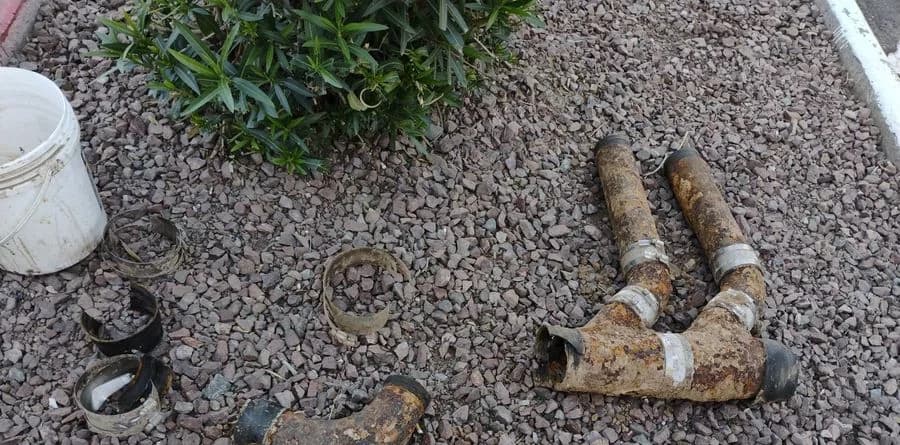
From a JB job
The failure was on the inside all along
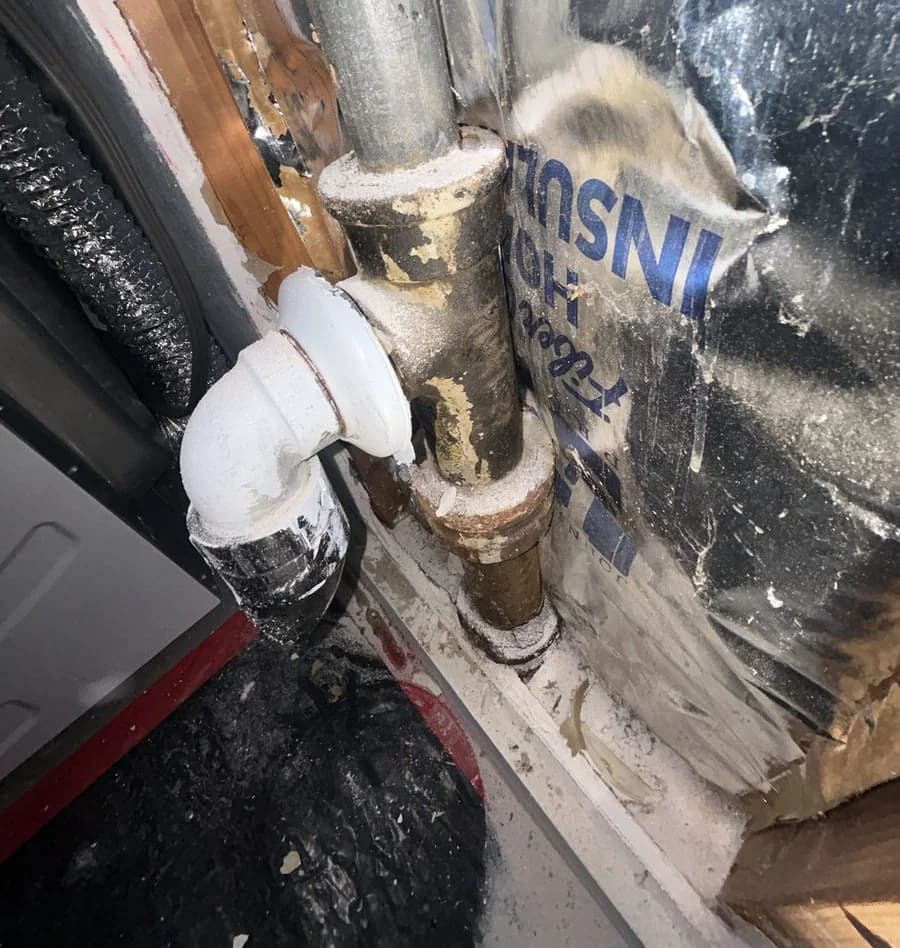
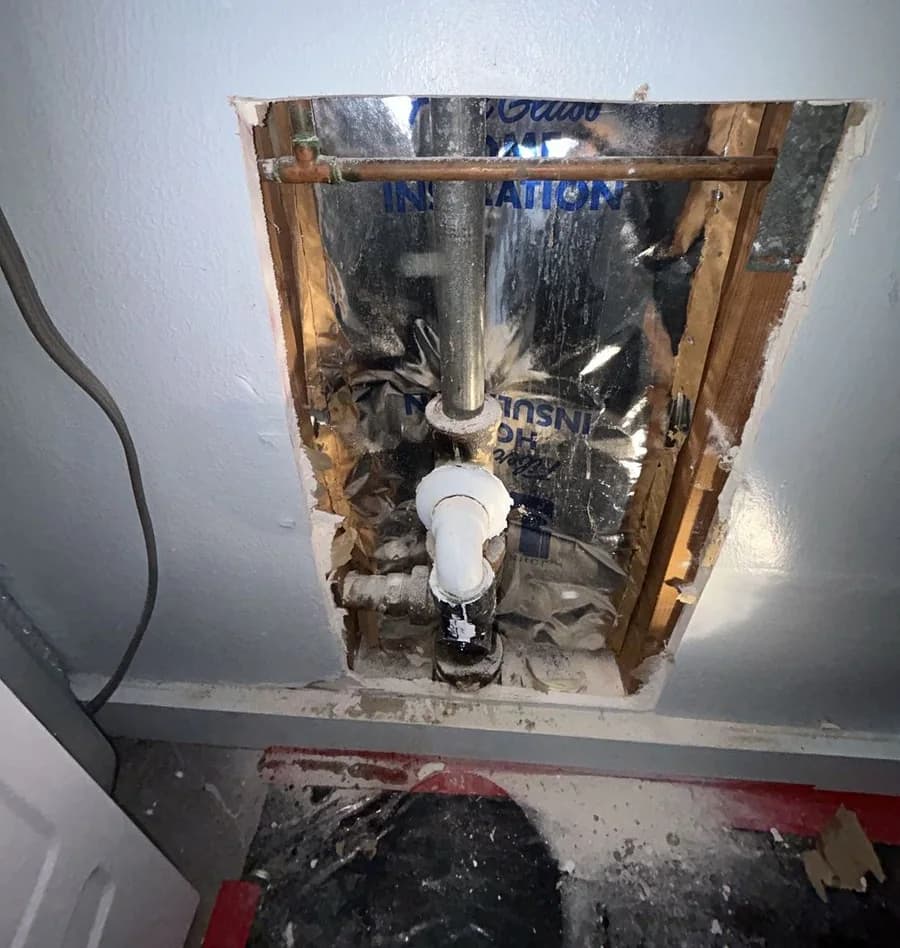
These are photographs from one JB removal, not renderings. The stack looked ordinary in the wall. It was only cut open, out of the ground, that the scale and pitting eating it from the inside became visible, which is exactly why the camera comes before the verdict.
Do the arithmetic
An inch of scale does not cost you an inch
Buildup sits on the wall all the way round, so it takes twice its thickness off the diameter, and the waterway falls with the square of what is left. Drag it and see.
Effective bore
2.5″
from a 4″ nominal line
Waterway left
39%
of the original cross-section
Behaving like a far smaller pipe. Backups return sooner after each clearing.
Describe what the line is doing and how often it backs up. That is usually enough to say whether a camera is the next step.
(480) 969-3193Reading the Symptoms
One fixture, or the whole house
Count the fixtures. A single slow lavatory with everything else draining normally is usually a trap or a branch local to that room. A slow sink, a gurgling shower, and a toilet that pushes water into the tub are one restriction seen from three rooms, and it sits downstream of all of them. How to tell whether your main sewer line is clogged works through that pattern.
Roots use the joints
Cast iron joints are where roots get in, and once fine roots are inside they catch paper and solids until the combined mass restricts flow. Clearing removes the mass. It does not close the opening that admitted it, which is why root stoppages return. Tree roots in sewer lines covers the sequence from clearing to inspection to repair.
Confirming Condition Before Choosing a Repair
A camera pushed into a blocked or heavily coated line shows the blockage and the coating, not the pipe. Mechanical drain cleaning or hydro jetting takes buildup back toward the wall so a second pass can show what the iron is actually doing. On badly deteriorated iron, expect the assessment to come before the pressure rather than after it.
Repair, Line, or Replace
What the camera shows decides the method, not the age of the house. An isolated defect in otherwise sound pipe can take a sectional repair; a continuously corroded but intact and correctly graded run may qualify for an epoxy liner; collapse, severe channeling, lost grade, or several separate failures along one run point instead to pipe replacement, and some qualifying lines can be addressed through a small number of access points rather than one continuous trench, which the trenchless sewer repair guide sets out. Aging supply piping is a separate scope again, covered on the repiping page. If the property is changing hands, scope the drainage before closing rather than after, for the reasons set out in plumbing due diligence in Arizona real estate transactions.
What goes back in
The materials, and when each one fits
ABS drain pipe
The usual replacement material for residential drainage in this area. Solvent welded, light to handle in a tight trench, and smooth enough inside that buildup has far less to hold onto than corroded iron.
PVC drain pipe
Similar service to ABS with a different jointing method and different code and transition detailing. Which of the two is used commonly comes down to local practice and what the rest of the system is already built from.
Cured in place epoxy liner
A new interior surface formed inside the existing pipe, which is why it can reduce excavation. It depends entirely on the host pipe still being continuous and correctly graded, so it is decided after the survey, never before.
Replacement cast iron
Still specified where sound transmission matters, such as a stack running past a bedroom wall, or where an existing cast iron system is being matched. Heavier and slower to install than plastic.
Sleeve and no-hub coupling repairs
Mechanical fixes at a single accessible point. Useful for an isolated defect on exposed pipe, and not a substitute for addressing a run that is thinning along its length.
The sequence
Clean, inspect, locate, then choose
Choosing a method before this sequence is choosing against a guess. The order is the point.
Establish the pattern
How many fixtures are involved, how often the line has backed up, and what has already been done to it. This comes first because it decides whether the next step is a branch, a trap, or the building drain.
Clear, then clean back to the wall
Mechanical clearing or jetting removes the blockage and then the buildup behind it. Order matters: a camera in a coated line records the coating, not the iron underneath it.
Survey and locate
The cleaned line is camera surveyed and any defect is located from the surface. A defect without a locate tells you a problem exists but not where the work would happen.
Match the method to the condition
Spot repair, lining, or replacement is chosen against the surveyed condition, the grade, the route, and the surfaces above it. Choosing a method before this step is choosing against a guess.
Inside step three
What honest footage has to name
A camera pushed into a coated line records the coating, not the iron. Clean first, then a survey that earns its place should account for all of this.
The route inspected
Which line, from which access point, in which direction.
How far it traveled
Distance run and the footage at each feature that matters.
Where it stopped
The point the head could go no further, and why it stopped there.
What could not be seen
Lengths obscured by standing water or buildup, named as unseen rather than passed as clear.
And the defect list
A useful survey calls out each of these where it appears, by location:
- Scale and buildup
- Open or offset joints
- Cracks
- Roots at the joints
- Low sections holding water
- Any point where the invert is missing
Footage without a surface locate proves a defect exists, but not where to dig for it. Two recordings from different dates say more than one pass does.
Before any figure
What drives the scope of a cast iron quote
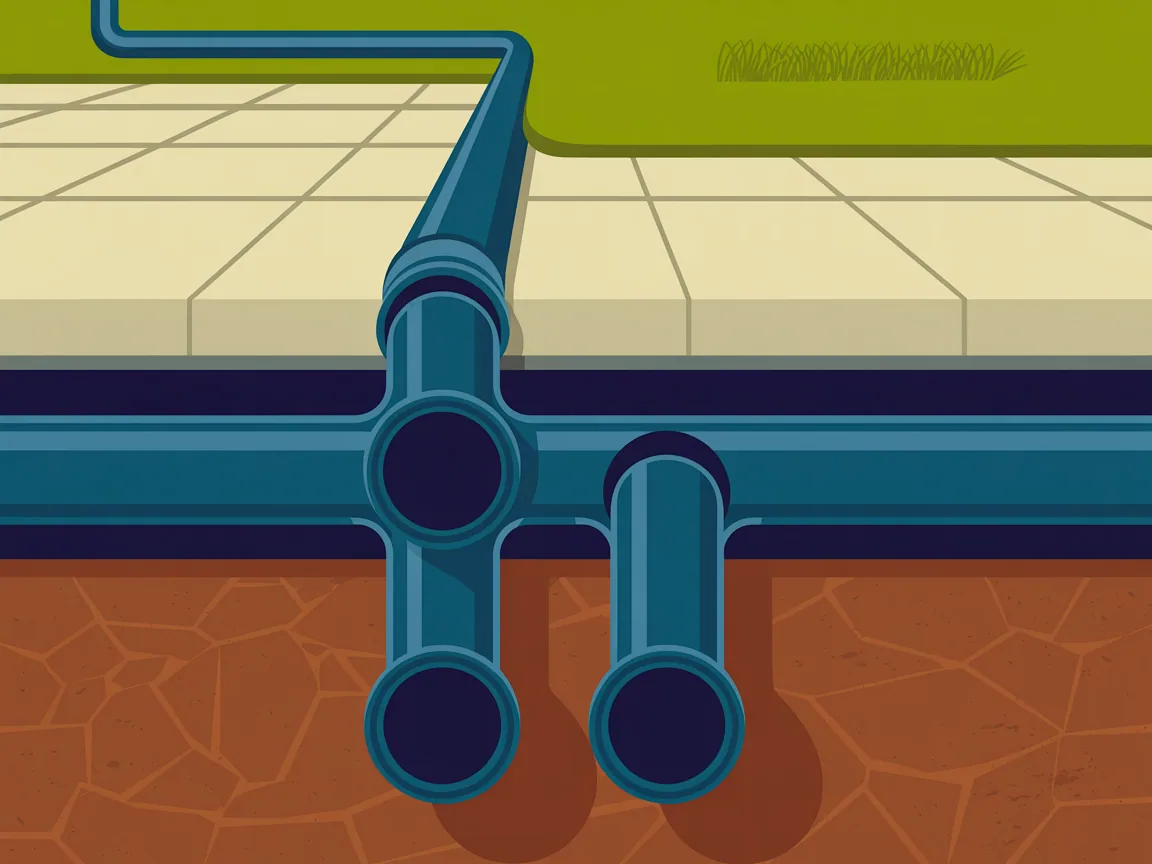
The scope follows the route. What sits above each stretch of the run, slab, hardscape, or open yard, decides how much ground gets opened and put back, and that is why the work is itemized before anything is priced.
Ask for it broken out
A cast iron quote, line by line
There is no honest figure before the line has been cleaned, camera surveyed, and located. What a scope can do first is name what drives it.
- Feet addressed
- The length of line in scope, and where it starts and ends.
- Method per segment
- Spot repair, liner, or replacement, matched to the surveyed condition of each stretch.
- Depth and surface above
- Slab, yard, or hardscape over the run, because the surface decides the disruption.
- Branch connections reinstated
- How many tie-ins have to be cut back in, and where.
- What the excavation cuts through
- Caliche and existing hardscape slow a trench and belong in the scope, not the surprise.
- Restoration standard
- Which surfaces are put back and to what finish.
- End re-inspection
- What is camera-verified once the work is complete.
Request an evaluation
Describe the line, or just call
Share the approximate age of the house, which fixtures are affected, how often the line has backed up and when it was last cleared, and whether any drainage has already been replaced. Existing camera footage helps.
(480) 969-3193- You send the history, or call and describe it.
- The team confirms the specifics and arranges to look at the line.
- You agree the scope, itemized by the line, before any work begins.
Workmanship is documented on the job paperwork rather than promised here in the abstract.
Questions people ask
Straight answers
Does a repair sleeve work on cast iron pipe?
- A sleeve or no-hub coupling can hold a small defect on exposed pipe, and it is genuinely useful on an accessible stack or a length running through a garage or utility space. It is a mechanical patch over one spot, not a repair of the pipe around it. If the surrounding iron is thinning at the same rate, the next failure appears beside it.
Can you hydro jet cast iron pipe?
- Sometimes, and the condition of the pipe decides it. Jetting cuts scale and buildup back toward the wall, which is what makes an honest camera survey possible afterwards. On iron that has already lost significant wall, pressure can open a hole that the buildup itself was plugging. That is useful information, but it is better expected than discovered.
What is involved in cast iron pipe replacement under a slab?
- Access, mostly. The line is located from above, the concrete is cut along that route, the trench is dug through whatever lies beneath it, new pipe is laid to grade, and the slab is restored. Caliche often sits under Valley slabs and slows that trench. If the foundation is post-tension, the tendons are located before any cutting starts.
Does an older home automatically need cast iron replacement?
- No. Age tells you that evaluation may be worthwhile; it does not establish failure. Original cast iron in Mesa homes from the 1950s and 1960s is often still carrying flow. What decides the answer is the observed wall thickness, how much bore remains, whether the invert is intact, the grade along the run, and the backup history.
How do I request a cast iron evaluation?
- Call (480) 969-3193 or use the contact page. Share the approximate age of the house, which fixtures are affected, how often the line has backed up and when it was last cleared, and whether any drainage has already been replaced. Existing camera footage helps, because two recordings from different dates say more than one pass does.
Related plumbing services
Find out what the cast iron is doing
Slow drains across the whole house, not just one fixture, is the pattern worth a camera.